


Finished! Looks like this project is out of data at the moment!
Research
By transcribing and finding names, we can make these documents much easier to search, browse, and share online. This work changes Black women's history!
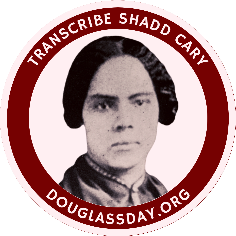
Mary Ann Shadd Cary
Learn more about Mary Ann Shadd Cary on the companion digital exhibit: Mary Ann Shadd Cary's Herstory in the Colored Conventions
Who was Mary Ann Shadd Cary?
Mary Ann Shadd Cary was born on October 9, 1823 in Delaware. Her early life was shaped by a sweeping tide of state laws (called Black Codes) that discriminated against the rights and liberties of African Americans. Thanks to these laws, it was increasingly difficult for free African Americans to vote, get an education, or earn a living. Shadd Cary spoke out against these injustices through her writing and the early parts of her career as a teacher.
Her life changed dramatically in the 1850s. The passage of the Fugitive Slave Act in 1850 required all people–North and South–to participate in supporting the system of slavery. These laws and the accompanying rise in racist violence made Shadd Cary decide to leave the United States and move to Canada. She lived in Canada for more than a decade. During her time in Canada, she founded civic and mutual support organizations. In 1853, she founded a newspaper called the Provincial Freeman. Alongside that editorial work, Shadd Cary wrote many letters and essays to encourage others to emigrate from the United States to Canada. She continued to be an active member of the Colored Conventions and a leading voice in local Ontario discussions about how to best improve the lives of recently arrived refugees from the United States.
When the Civil War began, Shadd Cary returned to the US to serve as a recruiter for the Union Army. She traveled widely in Indiana and Connecticut, among many other places. After the war, she moved to Washington DC where she would become one of the first Black women to attend law school. After graduating from Howard University, she continued to be a leading voice in the struggles for Black women’s civil rights and social justice until her passing on June 5, 1893.
Mary Ann Shadd Cary (1823-1893) was always ahead of her time. She is one of the unsung heroes of nineteenth-century Black activism. During a time when Black rights were a distant hope, at best, and women were not supposed to take part in public affairs of politics and publishing, she broke many barriers. As she wrote in an 1849 letter to Frederick Douglass, “in anything relating to our people, I am insensible of boundaries.”
Major Life Events
1823 - Born in Wilmington, DE (Oct 9)
1849 - Self-published Hints to the Colored People of the North (no known copies survive)
1851 - Emigrated to Canada
1852 - Self-published A Plea for Emigration; or Notes of Canada West
1853 - Founded The Provincial Freeman newspaper
1856 - Married Thomas Cary
1863 - Returned to the US to recruit Black troops for the Union Army
1869 - Enrolled at Howard Law School
1880 - Founded the Colored Women's Progressive Franchise Association
1893 - Died in Washington, DC
What are the goals of this project?
Transcribe Shadd Cary will help expand what we know about African American history! This project is the very first time that the papers and records from Shadd Cary's life have been gathered in one place. The transcribing activities will make these newly digitized collections so much easier to search and read. The activities to "Find the Names" will help researchers trace her relationships over the decades, including her family, fellow activists, and wider communities.
By participating in Douglass Day 2023, you can be a part of a project to remember heroic women like Shadd Cary whose legacies are too often forgotten. You can help restore the names of the everyday people who fought for Black freedom and civil rights.
Once we finish transcribing & finding all of the names, we will be publishing the results of this project online in a few places. A dedicated website will make it possible to explore the results of our collective efforts. We will also be sharing the results of our work with the libraries and archives that contributed these materials. Follow @DouglassDayorg on Twitter for future announcements!
Where do these papers come from?
The materials for this project come from a handful of different libraries and archives. The largest collections are housed the Archives of Ontario and at the Moorland Spingarn Research Center at Howard University. There are a number of other resources that come from Libraries and Archives Canada, the Amistad Research Center, and a host of others. Many of these papers have only been digitized in the last few years for this project. We are delighted to recognize the tremendous work of our many collaborators, including archivists and librarians at these organizations and to the extended Shadd family who has done so much to carry on their ancestor's incredible legacy.
Where can I learn more about Mary Ann Shadd Cary?
- Mary Ann Shadd Cary Companion Exhibit: Mary Ann Shadd Cary's Herstory in the Colored Conventions
- Buy the biography by Jane Rhodes, Mary Ann Shadd Cary: The Black Press and Protest in the Nineteenth Century