


Actualité de juin 2026 ! Que vous soyez un nouveau ou un participant de longue date, nous aimerions mieux comprendre vos motivations et l’impact de votre participation à Wild Mont-Blanc. Répondez à notre enquête et faites avancer la recherche !
Research
The project
Wild Mont-Blanc is a program developed by the Research Center for Alpine Ecosystems (CREA Mont-Blanc, a nonprofit research center based in Chamonix-Mont-Blanc, France) and initiated by the Communauté de Communes de la Vallée de Chamonix-Mont-Blanc.
CREA Mont-Blanc studies the impact of climate change and human activities on the evolution and functioning of high-altitude ecosystems, from the upper forest limit to rocky environments. The aim is to understand how alpine species can (or cannot) adapt to these changing environmental conditions. Wild Mont-Blanc is part of this approach, complementing CREA Mont-Blanc's existing monitoring of climate, vegetation and human activity changes. The data collected by the Wild Mont-Blanc programme offers a level and quality of information that is currently inaccessible to artificial intelligence software.
This project was financed by "Agence de l'environnement et de la maîtrise de l'énergie - Programme d'Investissements d'Avenir" and by "Communauté de Communes de la Vallée de Chamonix-Mont-Blanc".

Our camera traps are installed every 200 metres along an altitudinal gradient, allowing us to monitor the full range of natural habitats in the Mont Blanc massif, from forest and shrublands to meadows, and accross contrasting areas (with or without pastoral activity and with or without ski lifts, etc).
Why this project ?
Studying how animals —mammals and birds— use space and how this use changes in response to shifts in their environment is complex, especially in mountainous areas that are difficult to access. Camera traps provide a powerful tool to monitor animal activity using a reproducible protocol.
Since 2018, CREA Mont-Blanc has been deploying its network of cameras between 1,300 and 2,700 meters above sea level on the various slopes of the Mont Blanc massif. Since 2024, this monitoring has also been extended to the Bauges and Belledonne massifs. These camera trap networks allow researchers to study variations in animal space use across contrasting ecological and human-influenced contexts. Today, the network includes around 60 cameras in the Mont Blanc massif, with an additional 11 and 23 cameras in the Bauges and Belledonne ranges, respectively.
This network provides essential data for understanding which habitats are used by each studied species, as well as seasonal and annual variations in response to climate change and human activities. The cameras also enable tracking of altitudinal migration, activity patterns (diurnal vs. nocturnal), feeding behavior, moulting periods, and many other aspects of animal behavior.
The Mont-Blanc massif
The Mont Blanc massif is located in the heart of the Alps, at the crossroads of France, Italy and Switzerland. Its spectacular landscapes create a wide variety of climatic conditions and ecosystems at altitudes of over 4,500 metres. Since the beginning of the 20th century, temperatures in the Alps have risen twice as fast as in the northern hemisphere as a whole. These conditions, combined with the diversity of mountain leisure activities, make the Mont Blanc massif a veritable natural laboratory for studying high-altitude ecosystems and examining how they respond to climate change and human activities.
The Bauges and Belledonne massifs
The Bauges and Belledonne massifs stretch between Savoie and Haute-Savoie for the Bauges, and Isère for Belledonne. They feature mid-mountain landscapes, with peaks lower than those of the Mont Blanc massif: the Pointe de l'Arcalod and the Grand Pic de Belledonne reach heights of 2,217 and 2,977 metres respectively.
Long-term monitoring has been carried out since the early 1990s by the OFB (Office for Biodiversity) and the LECA (Laboratory of Alpine Ecology) in these massifs, in particular by capturing and tagging wild ungulates in order to better understand their ecology (demographics, movements, etc.). Chamois are specifically monitored in Les Bauges, while ibex are monitored in the Belledonne mountain range. The inclusion of these mountain ranges in the monitoring network makes it possible to analyse variations in the use of space by ungulates in very contrasting ecological and anthropogenic contexts, thereby enriching our understanding of the functioning and evolution of high-altitude ecosystems beyond the Mont Blanc massif.

Images from Belledonne camera traps showing the different markings observable on ibex:
A. Ibex with an identification collar (ID MG);
B. Ibex with ear tags (ID 407 - 400);
C. Ibex marked with ear tags, but unreadable;
D. Ibex GPS collar and no visible ID marks.
Zoom showing markings more clearly are presented in white boxes.

Images from Bauges camera traps showing the different markings observable on chamois:
A. Chamois with an identification collar (ID OA);
B. Chamois with an unreadable identification collar;
C. Chamois with both GPS and ID collars.
Zoom showing markings more clearly are presented in white boxes.
Scientific questions
Wild Mont-Blanc helps us answer the following questions:
In the mountain environments, how are animals distributed across different habitats, how do they use them, and how do their periods of activity vary?
- Do alpine species prefer certain types of habitats (e.g. shrubland vs. grassland) and why (e.g. shelter vs. food)?
- How does the use of space and time vary throughout the year? Do species migrate to higher altitudes in summer?
- Are they more active at night than during the day, and how does this activity vary depending on the habitat?
- Do climate change and human activities (leisure, pastoralism) explain these variations in the use of space and time? For example, do we observe avoidance behaviour in certain areas in the presence of livestock? Are animals more active at night in summer when temperatures are higher?
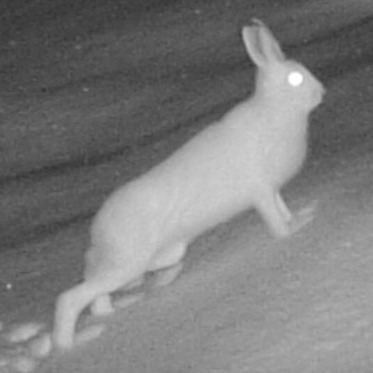
For species that depend on snow cover for camouflage through moulting, such as ptarmigan, ermines and mountain hares:
- Are they migrating to higher altitudes in response to climate change (i.e. decreasing snow cover)?
- Are they able to adapt their moulting dates?

A chamois in a shrubland
We need your help
Help us better understand the impact of climate change and human activities on Alpine species. With the Wild Mont-Blanc project, you will observe iconic species of alpine environments (chamois, ibex, marmot, mountain hare, red deer, roe deer, rock ptarmigan, black grouse) throughout the year and in all weather conditions, even at high altitudes!
Also keep an eye out for the identification numbers of the marked chamois and ibex in Les Bauges and Belledonne so you can let us know!