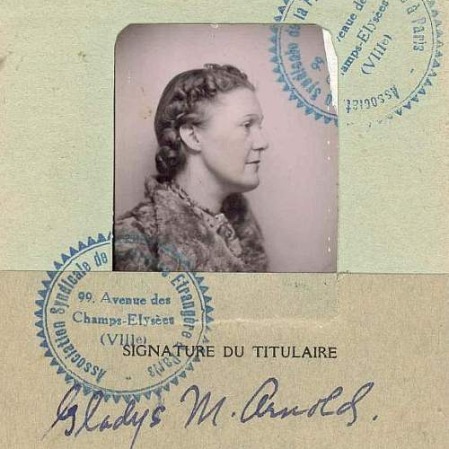
Gladys Maria Marguerite Arnold was born in Macoun, Saskatchewan in 1905. She taught in various rural schools before joining the Regina Leader-Post in April 1930. Arnold began as an editorial assistant but was soon writing editorials, feature articles, and news stories that were picked up by other newspapers.
Seeking adventure, Arnold left her job in 1935 and traveled to Europe. Arnold began submitting freelance pieces to the Canadian Press (CP) and shortly was hired as their full-time Paris correspondent. In the next four years she reported from France, Belgium, Switzerland, Germany, Austria, Czechoslovakia, Hungary, Italy and from the Spanish border during the Spanish civil war.
Gladys Arnold was the sole Canadian correspondent in France at the outbreak of the Second World War and she covered the early days of the conflict, the so-called “phoney war”, until the German occupation of Paris in June 1940. Returning to Canada, Arnold served with the CP Bureau in Ottawa until 1941 when she left CP to help set up the Free French Information Service in Canada. After the war this service was attached to the French Embassy in Ottawa and Arnold served as its Director until her retirement in 1971.
In 1987 Arnold published her memoirs about her wartime experiences, One Woman's War: A Canadian Reporter with the Free French (Toronto: J. Lorimer, 1987). For her service to France she was named Honorary Brigadier in the French Free Forces in 1940, and Chevalier de la legion d'honneur. In 1988 the University of Regina presented her with an honorary Doctor of Laws.
Gladys Arnold died in Regina in 2002.
This project focuses on a selection of materials from the Gladys Arnold fonds held at the University of Regina's Dr. John Archer Library and Archives. This selection spans the 1930s to the 1980s and consists primarily of Gladys Arnold's personal correspondence and journals, both handwritten and typed. In total, approximately 1,400 pages are available for transcription.
While we don't have a comprehensive inventory of all of the individuals with whom Gladys was in contact, we have identified several that she wrote to and received letters from regularly. We don't have biographical information for all of these individuals, but we hope to learn more about them through this project.
Hélène Comperot of France. According to these papers, she may have been living or working at a girls' school, Lycée de Jeunes Filles, in the French Free Zone during World War II.
Hazel Hart was originally from Saskatchewan but later moved to Ottawa, Ontario, Canada. Hazel was the Christmas Seal Supervisor for the Canadian Tuberculosis Association, where she worked from 1935 to 1965. Like Gladys, she had been a teacher in Saskatchewan earlier in life. She became involved as a tuberculosis campaigner after contracting tuberculosis in the 1920s and spending several years in the Fort Qu'Appelle Sanatorium ("Provincial TB Associations Honor Seal Sale Supervisor Hazel Hart", 1965).
Edna Hunt of Ottawa, Ontario, Canada.
Benjamin R. Kark, also known as "Karkie", of Vancouver, BC, Canada.
Irène Lézine (1909-1985) of Paris, France. Irene was an educational and developmental psychologist. She was also a translator, specifically of the works of Anton Makarenko and Lev Vygotsky, as well as being a member of the Communist Party, and the secretary of La Grande Cordée, a network founded by Fernand Deligny and aimed at supporting young people with severe intellectual disabilities outside of institutional settings (Miguel, 2022, p. 45). She authored several books, including The Imitation of Gestures: A Technique for Studying the Body Schema and Praxis of Children Three to Six Years of Age.
To make the most of volunteers' time, we first used HTRflow, an AI-powered handwritten text recognition tool, to generate draft transcriptions of the handwritten materials in the collection. HTRflow uses handwritten text recognition (HTR) technology, which is specifically designed to read handwritten text. This is different from optical character recognition (OCR), which works best with printed or typed text. Rather than asking volunteers to transcribe from scratch, we are asking you to review and correct the machine-generated output. This approach focuses your efforts where human judgement and attention to detail matter most, since AI tools can make errors that require a careful human eye to catch and correct. Of course, if you'd prefer to delete the AI-generated content and transcribe the letter from scratch, you're very welcome to!
For more detail on the project's goals and design, including information about how transcriptions will be used and answers to common technical questions, please visit our FAQs.
The transcriptions created through this project will make selected items from the Gladys Arnold collection full-text searchable, allowing future researchers to search by keywords such as place names, people, and other topics of interest. This will significantly increase the accuracy, efficiency, and scope of archival research. Scholars, students, and curious people from around the world access the Dr. John Archer Library and Archives, and your contributions will help them discover the rich information contained in this collection. We are aiming to make these materials available through an online digital exhibition, and will be crediting Zooniverse volunteers to acknowledge their assistance with this project. Volunteers will also be credited in any presentations or publications that we produce as a result of this project.
The University of Regina Archives preserves, promotes, and provides access to the recorded academic and cultural heritage of the University of Regina. Our archival collection consists of original materials relating to the University, its faculty, staff, and students, dating from the inception of Regina College in 1911 to the present day. This includes theses written and defended since the establishment of graduate programs in 1966. In addition, we collect private papers, particularly in the visual arts, journalism, and Saskatchewan literature.
The initial transcriptions of handwritten materials were created using HTRflow, an open source tool for handwritten text recognition. HTRflow was developed by the AI lab at the National Archives of Sweden (Riksarkivet). The code for HTRflow is available on Riksarkivet's GitHub at https://ai-riksarkivet.github.io/htrflow/latest/
Portions of the Field Guide and tutorial have been borrowed and/or modified with permission from the Field Journal Fix-Up project by the Academy of Natural Sciences of Drexel University.
Icons in this field guide are used under a paid, royalty-free license from The Noun Project. Please note that any reuse or redistribution may require a separate license or agreement directly with The Noun Project and/or artists.
Miguel, M. (2022). General Introduction. In Camering Fernand Deligny on Cinema and the Image (pp. 15–54). Amsterdam University Press.
Provincial TB Associations Honor Seal Sale Supervisor Hazel Hart. (1965, July-August). News Bulletin of the Sanitorium Board of Manitoba, 3.