


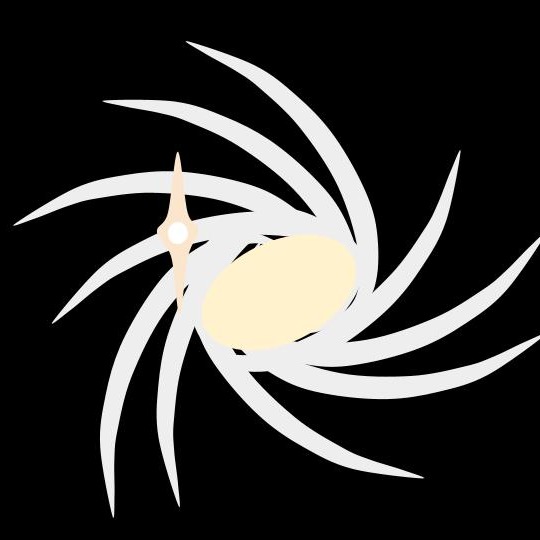
Final Data Drop! 1700 New images. Big thanks to everyone who came back one last time to help out, we really appreciate it!
Research
Research Introduction/Background
This zooniverse project involves studying supernovae in galaxy mergers.

(A collection of a few mergers)
In a galaxy merger, two different galaxies collide. These are chaotic events that depend on many things, including gravity, powerful supernova explosions, and the amount of gas inside the galaxies. These mergers have a large effect on the shapes of galaxies. For example, when two galaxies that look like the Milky Way collide, they eventually form into a more elliptical (blobby) shape. But before that happens, simulations tell us that these mergers cause a burst of star formation as the new system evolves.
Merger-caused star formation results in supernovae, which are the explosions at the end of a star's life. There are two ways that a supernova explodes. The first type is thermonuclear explosions, which happen when a white dwarf explodes after accumulating mass from a nearby star. The second type is core collapse; at the end of a star’s life, it runs out of fuel to push back against its own gravity. Once this happens, the star collapses and subsequently explodes (often referred to as a “rebound” or “bounce” stage).
We can get data on these supernova types from Blast, a database containing information for about 39,000 supernovae (so far!) and the galaxies where they formed. All the images you classify come from data on Blast.
The goal of this project is to find supernovae that exploded in merging galaxies. Citizen science is necessary for the research of this project because no two mergers look the same, making it difficult or impossible for computer programs to identify them. So: we need the help of as many people as possible to pick out these special merger cases!
From this study, we hope to learn how energy from supernova explosions affects how much mass leaves the system during mergers. These results may allow us to gauge how much supernova feedback contributes to the shutting off ("quenching") of star formation. We also hope to learn whether the increased gas density and turbulence in merging systems creates more high-mass stars than we see in Milky Way-like systems.
Studying the Initial Mass Function of Merger Environments
How many stars form at a given mass in the Universe? This is called the Initial Mass Function (IMF), and is a way for astronomers to look at how stars form in different galaxy environments. The question is whether the IMF is “universal,” or the same in all galaxies, or whether it changes across galaxies.

(An image showing a simplified IMF distribution, courtesy of Pearson Education, Inc.)
One roadblock for studying the IMF is that we can only observe individual stars in the most nearby galaxies. Astronomers directly analyze these stars to understand the IMF. But in order to check whether the IMF can change, we would need to measure it in many different galaxy environments. The dataset from this Zooniverse project can help with that.
As we said above, merger systems cause bursts of star formation. We would like to try and measure the IMF of these unique environments. Then, we can compare the results with current IMF studies of the Milky Way. But how could we understand the IMF if these merger systems are hundreds of millions of light years away?
The types of supernovae that we observe in these merger systems can help us gauge the initial mass function. Due to the nature of core collapse supernovae, they normally have progenitor stars more than 8 times the mass of the sun! But the more massive a star, the more quickly it dies. Because of this, the stars in merging systems that explode in a core collapse supernovae likely were born in these same merger starbursts. We can measure the ratio of higher mass core collapse supernovae (which are a special type of core collapse supernovae) to infer how many high mass stars formed during the merger starburst. If this ratio is different in mergers than in non-merging galaxies, it implies that the IMF is changing in these unique systems.
Observing How Supernova Feedback Limits Star Formation
Supernova feedback is a process in which the energy ejected from a supernova can send out a shockwave that pushes out nearby gas and dust. Supernovae produce strong shockwaves that can push gas and dust away from their local area and even outside of their galaxy. Currently, we don’t know what impact supernova feedback has on the limiting of star formation, or whether stellar feedback dominates.
First, with the help of citizen scientists, we will identify supernovae in merger systems. Then we can trace their brightness, thanks to information available on Blast, to estimate their released energy. From there, we can gauge how much gas and dust leaves the system due to the supernova. We can then compare this to models for how stellar feedback reduces (“quenches”) star formation, and understand which processes dominate galaxy merger evolution.
Again, none of this could begin without the help of citizen scientists, so a big thank you to everyone who helps out with classifications.