


Dear PhenoPulse Volunteer, thank you for your dedication and time on our images. We are making progress. Please note that we have uploaded new images from January to March 2025 taking us to almost 6 months of images. We hope to share some initial results soon. Thank you for your very important contribution.
Also, this project recently migrated onto Zooniverse’s new architecture. For details, see here.
Join us in tracking the time when plants produce leaves, flowers and fruits. For some trees, the timing of these stages is not well documented. Let us uncover this information together!
Learn moreThe project involves identifying leafing (new leaves, mature leaves, dry leaves, leaf shedding), flowering, and fruiting events from images of the canopy. For each image, please select what event you can observe and mark the spots where the observation or event was made.
Zooniverse Talk
Chat with the research team and other volunteers!
GhanaPhenoPulse Statistics
View more statsEvery click counts! Join GhanaPhenoPulse's community to complete this project and help researchers produce important results.
Message from the researcher
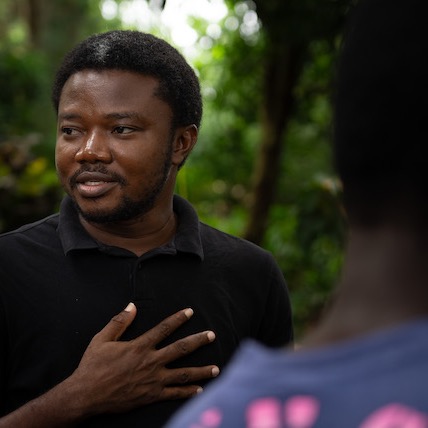
“The threat of climate change on forest health affects leaf, flower and fruit resource availability, but we cannot be prepared unless we have adequate data with predictive power. We are taking the steps but we will need your help to get there.
- Dr. Bismark Ofosu-Bamfo, Department of Biological Sciences, University of Energy and Natural Resources, Ghana
About GhanaPhenoPulse
Phenology, the timing of life cycle events, is all about studying natural events like when plants grow or shed leaves, bloom, and bear fruit. Leaves, flowers and fruits are important food resources for wild animals and in some cases human communities. This project focuses on monitoring the phenology of tropical forest trees and woody climbing plants in Ghana from canopy pictures.
We need your help to classify the observations from our pictures of the canopy. Phenology data has enormous importance, imagine being able to predict fruit decline ahead of time. How vital would this be for forest resource and range managers as well as local communities?
Collaborating organisations for this study are Department of Biological Sciences, Department of Atmospheric and Climate Science, both at the University of Energy and Natural Resources, Ghana and Department of Geo-Information Processing, University of Twente, Netherlands with funding support from Lacuna Fund.