Finished! Looks like this project is out of data at the moment!
This project is no longer active: please visit Space Warps - DES Vision Transformer.
The Team
Space Warps and Science Team
Aprajita Verma @aprajita
Aprajita is an astronomer at the University of Oxford, and previously worked at Imperial College London and the Max Planck Institute for Extraterrestrial Physics (Germany). She became fascinated by gravitational lenses during her PhD in which she studied some of the most luminous galaxies seen in the Universe, some of which have been gravitationally lensed. Aprajita is interested in making use of gravitational lenses as natural telescopes to study the galaxies that are being lensed in more detail than would normally be possible, as well as measuring the light and dark matter in the lensing galaxies themselves. Having worked with citizen scientists looking for gravitational lenses in Galaxy Zoo, she was inspired by their efforts, motivating the emergence of Space Warps. You can follow Aprajita on twitter at @aprajitaverma.
Anupreeta More @anupreeta
Anupreeta is an astronomer at IUCAA, India. She has been captivated by gravitational lenses ever since she first saw one. She likes to find these rare systems and study them to learn more about the mysterious dark matter and how it influences the galaxies hosted within. She led the first Space Warps project using data from the CFHT Legacy Survey. She's interested in developing better algorithms, for instance, combining machine learning with citizen science to find more lens systems with upcoming surveys. You can follow Anupreeta on twitter at @anupreeta
Tom Collett @tom_collett
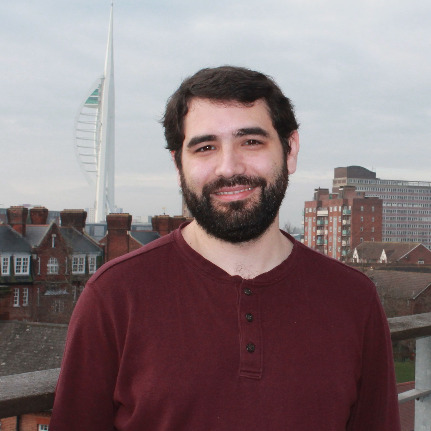
Tom is a research fellow at the Institute of Cosmology and Gravitation, University of Portsmouth, England. Tom's research focuses on using strong gravitational lenses to probe the expansion of the Universe. Tom is particularly interested in finding exotic lenses, with multiple background sources, as these can help us understand the mysterious dark energy. Tom is really interested in improving the lens finding process so that we are ready to find over 100,000 lenses in the next decade of astronomical surveys.
Colin Jacobs @coljac
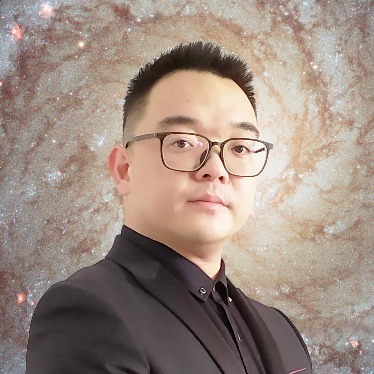
Colin is a postdoctoral researcher at Swinburne University of Technology in Melbourne, Australia. Before returning to astronomy, Colin spent over a decade working in the technology industry. Colin's research has involved the application of modern machine learning techniques, particularly neural networks, to the challenge of finding these beautiful gravitational lenses from among images of hundreds of millions of galaxies. Colin is interested in using the input from citizen scientists to help make AIs better at astronomy. Colin is on Twitter at @coljac
Phil Marshall @drphilmarshall
Phil is an astronomer at the Kavli Institute for Particle Astrophysics and Cosmology, Stanford University. After deciding he liked doing maths and physics problems at school and university enough to want to make up his own questions, Phil did a PhD at Cambridge University on using gravitational lensing to map the distribution of dark matter in galaxy clusters. Since then he has spent ten years as a research scientist using strong lenses to weigh galaxies, and investigating automated strong lens detection. He knows very well how hard it is to teach a robot to spot lenses - or at least, how hard it is to teach them not to be confused by large numbers of galaxies that are not lenses. You can follow Phil on twitter at @drphilmarshall.
Philip Holloway @philholloway
Phil H is an astronomer-in-training at the University of Oxford, where he's pursuing a DPhil (PhD) in Physics. He took his undergraduate degree at the University of Cambridge where amongst other things he studied microlensing (a different type of gravitational lensing) with data from the Zwicky Transient Facility. He's now focussed on searching for strong gravitational lenses and would love the help of citizen scientists to improve our lens finding algorithms.
Simon Birrer @sibirrer
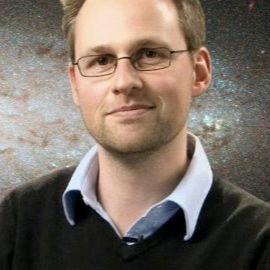
Simon is an astronomer at the Kavli Institute for Particle Astrophysics and Cosmology, Stanford University.
Simon got inspired to study Physics when participating in a physics competition in high school. When studying physics at ETH Zurich, he got interested in the many outstanding questions the Universe still holds as a secret and started a PhD in Cosmology. Simon is an expert in detailed analysis of strong gravitational lenses to learn about the expansion rate of the universe and how we can use the distortions caused by gravitational lensing can help us understand the nature of dark matter on a more fundamental level. Albeit Simon sees himself more as a theoretician, looking with his own eyes on data provided a lot of insights, intuition, and improved analyses.
Space Warps Moderators
Elisabeth Baeten @ElisabethB
Els has always been interested in science, and astronomy in particular, but choices and career moves steered her in a very different direction. So, when she discovered GalaxyZoo, it was the chance of a lifetime to get seriously involved. This resulted in, among other things, moderating the discussion in several different projects (Solar StormWatch, Old Weather, IceHunters and recently for GalaxyZoo Talk) and classifying in many more. Before GalaxyZoo came along she had only some vague notions of what a gravitational lens was, but she quickly became intrigued by them and spent hours searching the SDSS images for potential lenses. She is looking forward to doing some serious lens hunting!
Christine Macmillan @Budgieye
Christine, a retired biologist and planetarium presenter, participates in citizen science, classifying in Galaxy Zoo and posting in the TALK forum. She has always been fascinated by the sky, starting with the Moon when a small child, then the solar system and stars, and then learning about galaxies and gravitational lenses in a natural progression of expanding horizons.
Claude Cornen @c_cld
Claude was an IT development manager and is now retired after a long professional life in the French consumer loan business. He could then take his time reading, learning history of sciences and attending lectures on astrophysical topics. In volunteering on Zooniverse projects , he uses his ability in data mining to respond to calls for "wanted" objects in the Galaxy Zoo forum like "peas", "overlaps", "AGN with ionized clouds", and "strong gravitational lenses."
Julianne Wilcox @capella05
Julianne stumbled across Galaxy Zoo several years ago following a report on BBC. Having been an avid amateur astronomer since childhood, she found the London skies somewhat lacklustre. After realising classifying galaxies was an excellent way to get back into astronomy, she has gone on to participate in many projects. Although not from a science background, she has found the Zooniverse to be an excellent way of learning new concepts, while making a valid contribution to science. When not glued to her PC participating in citizen science, she can be found testing and analysing software systems.
Zooniverse Team
Of course none of this would even be possible without the fantastic work of the Zooniverse team, past and present, both in developing the platform and systems that this project runs on and uses but also for considering all of the Space Warps requested features and answering our many questions. Thanks to you all!