



Finished! Looks like this project is out of data at the moment!
This project is no longer active: please visit Space Warps - DES Vision Transformer.
Research
Gravitational lensing
Needles in a Haystack
About the Survey
Gravitational Lensing
Einstein's theory of gravity, General Relativity, made a remarkable prediction. Massive objects, such as stars, would bend the space around them such that passing light rays follow curved paths. Evidence for this revolutionary theory was first obtained by Arthur Eddington in 1919, when during a solar eclipse he observed that stars near the edge of the Sun appeared to be slightly out of position. The Sun was behaving like the lens in a magnifying glass and bending the light from the background stars!
In 1937, Fritz Zwicky realized that massive galaxies (which can contain anywhere from ten million to a hundred trillion stars) or clusters of galaxies could be used to magnify distant galaxies that conventional telescopes couldn't detect. As you can see, not unlike a conventional magnifying glass, these gravitational lenses not only magnify and focus the light of the distant background galaxies but they can, and mostly do, distort them as well.
When one of these gravitational lenses happens to sit right in front of a background galaxy, the magnification factor can be up to x10 or even more, giving us a zoomed-in view of the distant universe, just at that particular point. Lenses can help us investigate young galaxies more than halfway across the universe, as they formed stars and started to take on the familiar shapes we see nearby.
Observations of the distorted background galaxy can also give us useful information about the object that is behaving as a gravitational lens. The separation and distortion of the lensed images can tell astronomers how much mass there is in the object, and how it is arranged. It is one of the few ways we have of mapping out where the dark matter in the universe is, how clumpy it is and how dense it is near the centers of galaxies. Knowing this can provide crucial information about how galaxies evolve.
Go to the Top
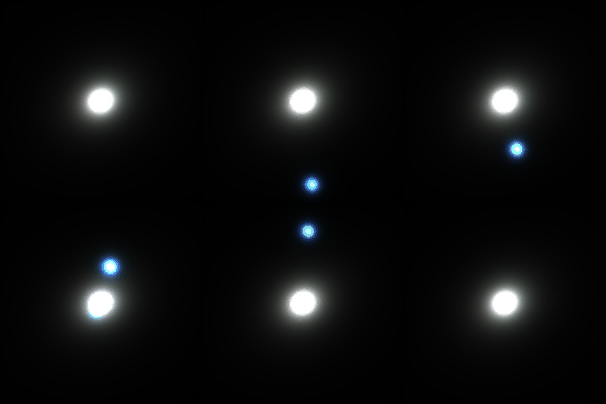
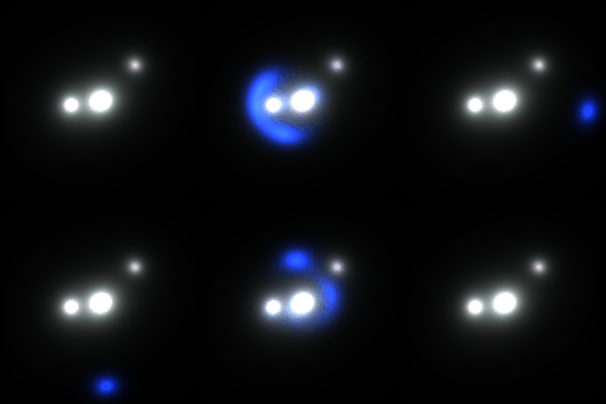
See the following lensing animations showcasing the lensed image configurations that can usually form.
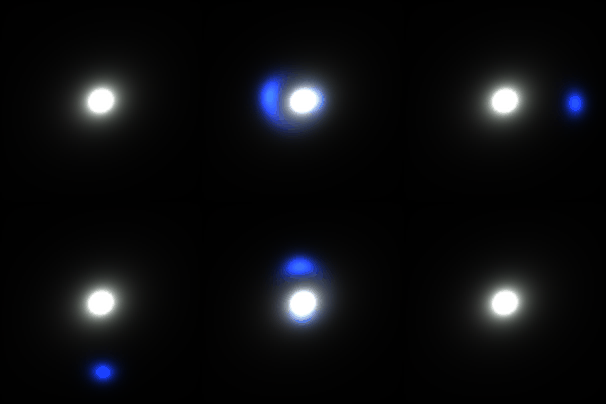
Left: A distant background galaxy moves across a massive elliptical galaxy in the foreground
Center: A distant background quasar moves across a massive elliptical galaxy in the foreground
Right: A distant background galaxy moves across across a galaxy group in the foreground. The configuration of the lensed images can be very different based on how the multiple galaxies are arranged in the galaxy group.
Video credits: Alessandro Sonnenfeld.
The speeds of the background galaxies/quasars are too slow for us to see the changing image configurations in our lifetime. In reality, we only see a single static configuration.
Needles in a Haystack
There is a lot of interesting science to be done with gravitational lenses, from precisely weighing galaxies to measuring the expansion rate of the Universe. The problem is that they are very rare. Only about one in a thousand massive galaxies is aligned with a background object well enough to cause it to appear multiply-imaged. We currently know of about 700 objects that are behaving as gravitational lenses, largely because we have become very good at observing the night sky! Modern optical surveys cover thousands of square degrees, with images sharp and deep enough to resolve about 1 lens per square degree. There should be thousands of lenses that we can detect, but we will need to look at millions of galaxy images to find them!
The ideal solution would be to get a computer to look through all of the images, but unfortunately this is not a straightforward solution. Teaching a computer to recognize the effects of gravitational lensing is challenging, as they can be easily confused by galaxies that look very similar to a distorted background galaxy. Here we combine the outputs of such a computer program with the input from citizen scientists get the best of both worlds: computer speed and human intuition.
Human beings have a remarkable ability to recognise patterns and detect the unusual with only minimal training. With a basic understanding of what the distorted images of galaxies that have passed through a gravitational lens look like, participants in the SpaceWarps project can help discover new examples of this amazing phenomenon, and enable our survey scientists to carry out new investigations of stars and dark matter in the Universe.
The Dark Energy Survey
The DES is an international collaborative effort to survey the Southern sky, covering 5000 square degrees (1/9 of the entire sky) in 5 filters. DES's primary goal is to understand the expansion of the Universe and to measure the properties of the mysterious 'Dark Energy' that is believed to cause the observed acceleration of the Universe's expansion. Within the Dark Energy Survey dataset there should be a few thousand gravitational lenses, but despite the best efforts of the DES strong lensing team we've only found ~500 candidates. DES is just too large for experts to look at everything so we need your help!
We will be showing images centred around galaxies that are massive enough to potentially act as gravitational lenses. The task will then be to assess whether or not they actually are!
This is a tricky mission: nature is very creative, and there are galaxies of all shapes and colours out there, many of which can mimic the features of a genuine gravitational lens. You can learn more about them under Education.
The challenge is to come up with the most plausible explanation for what is going on, in collaboration with the rest of the SpaceWarps community. Do you think you can spot outer space being warped?
A head start on finding lenses from artificial intelligence
With this lens search, for the first time we are combining the skills of our citizen scientists with artificial intelligence. Instead of just showing images of galaxies chosen randomly from the survey, or chosen because of their colour or brightness, we are choosing images to show based on the output of an AI system. We've done this because the DES dataset is so large that it's impractical to screen everything, even with citizen help. AI is giving us a head start by filtering out lots of the non-lenses, though most images still don't contain real lenses.
Our code uses convolutional neural networks, a machine learning technique designed for use on image data — the same one that drives modern tools like facial recognition in photographs — to score images on their likelihood of being a gravitational lens. Not only will you be able to discover new lenses, when you mark something as 'not a lens' we'll feed that back into our AI system so it will get a little bit smarter at discriminating confusing objects. With this training, the AI will get better at choosing objects to show you that are likely to be lenses. This way, humans and AI will discover together!