



Check out our new workflow: "Fermi: Pulse shapes"! It includes over 2000 new GRBs from the NASA Fermi Gamma-Ray Space Telescope. Please help us classify these GRBs! (The Fermi workflow is only available in English at this moment.)
FAQ
Which workflow should I start first?
You can start with whichever workflow that you find more interesting. If you would like to have more guidance of the difference between pulse and noise and different pulse shapes, start with the "(Optional) Practice: Pulse or Noise?" workflow and the "(Optional): Practice: Pulse Shapes: on the main page here. Remember that the pulse shapes can be subjective sometimes and it is okay to disagree with the answers. Please check the "i" icon under the figure in the pulse shape practice for more description and learn about why astronomers choose the specific pulse shapes.
How do I switch from each workflow?
To switch from each workflow, or to get out of the optional practice workflow, please go back to the main page by clicking the white Burst Chaser text on top of the page and choose the workflow that you'd like to work on. If you click the "Classify" link, it will bring you to the last workflow that you worked on.
Where can I find some examples of each pulse structure?
Please go to the Field Guide to see some examples of each pulse structure.
What is the blue region in the light curve plot?
The blue region marks the main burst emission. This region is found automatically by computer algorithm. Please pay attention to structures inside the blue region, since structures that lie outside of this region are likely to be noise.
Occasionally, you may see a plot that does not have any blue region, despite an obvious pulse shown in the plot. Those are usually because the pulse is too short so that the computer program failed to plot the blue region. In those case, please use your best judgement. (And these are examples that computers are not always right and we rely on you to help us!)
We have classified a lot of gamma-ray bursts, when will we be done?
Because the complexity of the pulse shapes, we adopt a more complicated retirement rule than those usually adopted on Zooniverse. To make sure we have good statistics and a robust classification, a gamma-ray burst needs to (1) have more than 10 classification, and (2) more than 90% of the people need to agree on the pulse shape. If both of these criteria are satisfied, the classification will be registered for this gamma-ray burst, and this gamma-ray burst will be retired from the sample (meaning that you will not see this burst in the workflow).
We have a back-end code to check whether a gamma-ray burst passes the criteria described above. And we set the Zooniverse retirement limit to an artificially high number (100), to make sure no gamma-ray burst will be retired by Zooniverse before passing our additional criteria.
If some bursts end up having a lot of classifications, and people still do not reach a consensus of the pulse shape, the Burst Chaser team will double check these bursts, and retire them from the sample if the pulse shapes turn out to be too ambiguous to be placed into one single classification.
Can I do the classification on the Zooniverse app using my cell phone?
No. Unfortunately, the Zooniverse app on your cell phone is incompatible for our current workflow setup. But Burst Chaser will work on the web browser on your cell phone.
What is the difference between a pulse and noise?
Please go to the "What is a pulse?" section in the field guide for this information. You can also play with the (Optional) Pulse or Noise workflow on the main page for some practice.
When should I use the "Talk" button under each burst?
If you see any problems with the light curves, or have any questions for the bursts, you can use the "Talk" button at the end of each burst classification.
Some light curves have a period with zero counts, what are those?
When the light curves have zero counts, it means the telescope cannot see the gamma-ray bursts. You can simply ignore those parts of the light curves.
If I am interested to learn more about a specific GRB, where can I find more information?
Click the meta data icon  under the light curve, and you will see several links that lead to more detail information of this GRB. Information in these links are used by astronomers to perform science research. If you have any questions, submit them in the talk section!
Which telescope(s) detects these GRBs?
The GRBs you see in the Burst Chaser project are detected by the Neil Gehrels Swift Observatory (a.k.a. Swift) and by the Fermi Gamma-ray Space Telescope. Swift is one of NASA's space telescope dedicated to the study of GRBs. Swift was launched in 2004, and have detected over 1600 GRBs (as of 2026). The Fermi Gamma-ray Space Telescope can see an even larger portion of the sky than Swift and is dedicated to study the gamma-ray sky. The GRBs from Fermi can be found in the workflow "Fermi: Pulse Shapes" which includes over 2500 detections from Fermi since its launch in 2008.
What is telescope slew time? Does it affect the light curve?
The Swift Burst Alert Telescope are constantly looking all over the entire sky when waiting for a GRB to occur. When the telescope is "slew" from one location to another, it is called the telescope slew time. During this time, you may see the noise level changes. That is, the light curve might change more less noisy to more noisy, or vice versa.
What happens if I'm not sure of the category?
You may find the pulse shapes of some GRBs remain ambiguous and it may not be easily fit in to one category. This is exactly why we need your help as a citizen scientist. The pulse shape identification can be subjective and even professional astronomers may not easily come to an agreement sometime! Use your best judgement to determine the category that you think best matches with the examples provided in the Field Guide, and stay consistent with your idea of what each category is tailored by the information we provide.
How does classifying light curves help astronomers probe the physical origins and emission mechanism of GRBs?
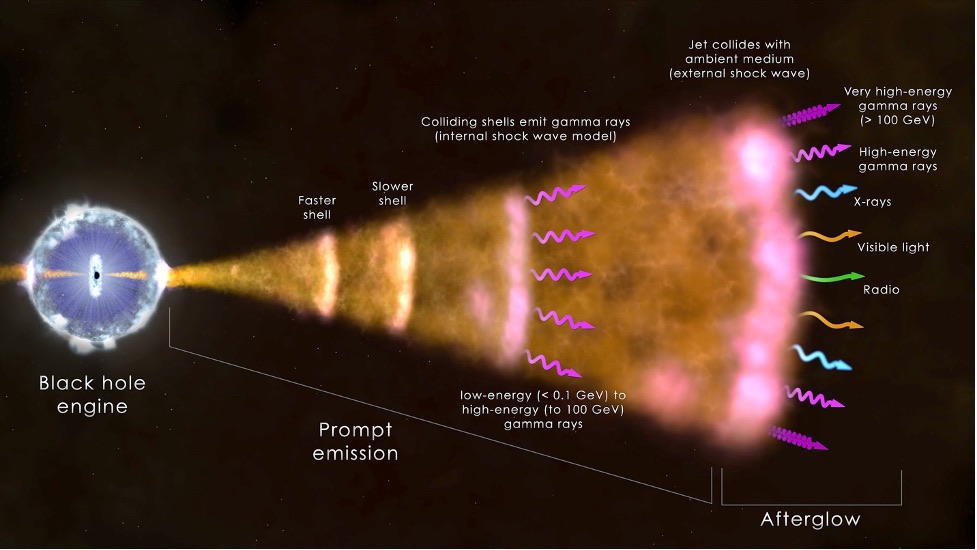
Figure credit: NASA/Goddard Space Flight Center/ICRAR.
The light curve structure of GRBs encodes a great detail of the emission mechanism. We are looking for the following structures:
-
Number of pulses and pulse durations: Current theories suggest that GRB prompt emission arises from individual interaction between shocks inside the jet (a.k.a. internal shocks), as shown in the picture above. Therefore, the number of pulses and pulse durations provide information of these internal shocks, and how they are created by the black hole engine.
-
Symmetrical/asymmetrical behavior of pulses: Whether the pulse is symmetrical or asymmetrical tells astronomers how the emission mechanism activities start and end.
-
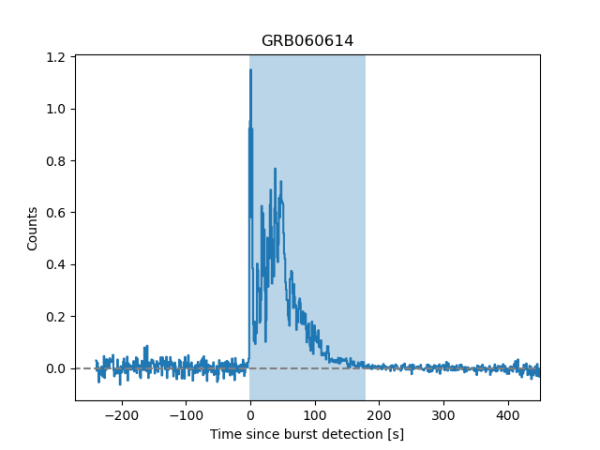
GRBs with initial pulses followed by extended emissions: GRBs with an initial pulse followed by extended emissions (like the one in the figure below) seem to have particularly confusing physical origins that challenge our standard picture. For example, GRB060614, the one shown in the following picture, have a duration of around 180 s, which would indicate that they are associated with supernovae. However, deep follow-up observations did not reveal any supernovae.
In addition, GRB170817A was the first and only GRBs with confirmed origin of a neutron-star merger, because of the coincidental detection of gravitational wave. However, this burst also presents a soft tail follow by the initial pulse (see figure below).
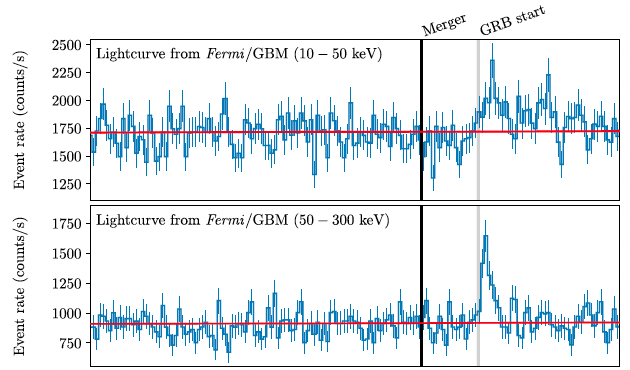
Figure credit: Abbott et al. ApJ Letters, (2017)
Having a complete sample of such events will help astronomers to better understand these mysterious bursts. For more examples of the light curves for these GRBs, check out the section “A pulse followed by extended emission” in the field guide.
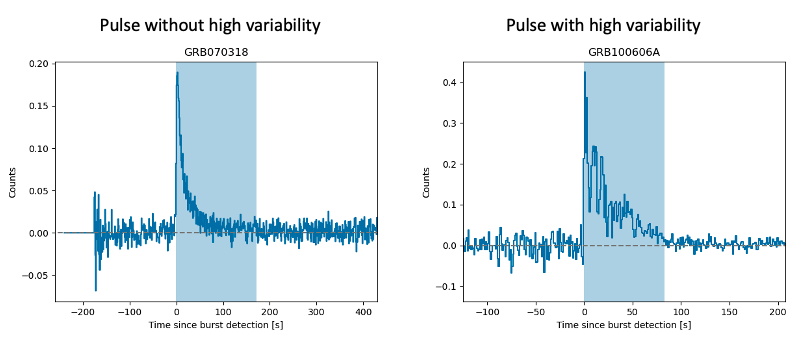
- The variability of each pulse: the variability measures how fast the structure changes. For light curves with high variability, you can see lots of fast fluctuation (in addition to regular noise) in GRB pulses. Figure below shows examples of with and without high variability. The variation tells astronomers the timescales of the emission mechanisms. High variability implies small emission regions. This is because light travels with a finite speed, and thus if the emission region is larger, the light travel time across the emission region would have smear out these short timescale structure.
For more details about gamma-ray bursts and related astrophysics, check out some of these sites:
The telescope that got the data we are currently using for the project:
NASA's Neil Gehrels Swift Observatory homepage
https://swift.gsfc.nasa.gov/
An excellent start on the subject from NASA:
https://imagine.gsfc.nasa.gov/science/objects/bursts1.html
An somewhat older 14 minute video giving a excellent over view of gamma-ray burst
Crash Course from Astronomer Phil Plait on PBS Digital Studios
An in depth look at Neutron Stars by Astronomer Matt O'Dowd on YouTube PBS Space Time:
Neutron Stars: The Most Extreme Objects in the Universe: