


Welcome! This project recently migrated onto Zooniverse’s new architecture. For details, see here.
Research
SuperWASP Variable Stars
Stars are the building blocks of the Universe and determining stellar parameters is a cornerstone of astrophysics. Variable stars are the key to this, as their time domain signal may be used to probe the dynamics or structure of a stellar system. The first step in such research is to identify and classify samples of variable stars, and that is the purpose of this project.
Classification of periodic variable stars based on the shape of the photometric variability displayed in their folded lightcurves is not always a conclusive way of uniquely determining their type. However, it can at least give a good indication of the possible type and identify candidates that are suitable for follow-up investigations, often involving spectroscopy.
SuperWASP is the Wide Angle Search for Planets, but the results it obtains also comprise a unique data set for exploring stellar variability. The SuperWASP stellar photometry archive is distinctive in two key ways. First, it is an all-sky survey (excluding only the Galactic plane) and so covers a homogenous sample of bright stars. Second, the lightcurves have both high cadence (many observations per night) and long baseline (spanning many years), so can be used to search for variability on all timescales from hours to years.
The purpose of identifying and classifying periodic variable stars in the SuperWASP data is also twofold. The first purpose is to identify large catalogues of objects of a similar type which can then be studied en masse to determine characteristics of the population; and the second purpose is to identify rare objects displaying unusual behaviour, which can offer unique insights into stellar structure and evolution.
Pulsating stars
Some stars exhibit periodic changes in brightness that are due to changes in the star's size and luminosity as its outer layers expand and contract in a regular manner. These so-called pulsating stars come in several varieties. Measurements of stellar pulsations are used to determine parameters of stars such as mass and radius. These deductions are based on stellar models, so large populations of such stars need to be investigated to test the models. Some of the most common types of pulsating star are RR Lyrae stars, Delta Scuti stars, Cepheid variables and Mira variables.
RR Lyrae stars are post main sequence, giant stars sitting on the so-called horizontal branch of the Hertzsprung-Russell diagram. As such they all have very similar intrinsic luminosity. They have pulsation periods typically around half a day. The RRab subtype have characteristic pulsation profiles with rapid increase in brightness followed by a more gradual decline, whilst in the RRc subtype the profile is less asymmetric. A large (but unknown) proportion of RR Lyrae stars display the so-called Blazhko effect which is an amplitude and/or frequency modulation of the pulse profile with a period of tens or hundreds of days.
Delta Scuti stars are main-sequence stars or sub-giant stars of early spectral type and exhibit pulsation periods of a few hours. Their pulsation profiles are typically saw-tooth in shape with a rapid rise and slower decline.
Cepheid variables are giant or supergiant stars with pulsation periods of days to months, whilst Mira variables are evolved stars on the asymptotic giant branch, and display pulsation periods of more than 100 days, often several years. Like other pulsating stars, the pulsation profiles of these types of star also display a relatively rapid increase in brightness followed by a slower decline.
In this classification project, it is often difficult to distinguish these different types from their folded lightcurves alone, so all types will simply be classified as pulsators.
Eclipsing binary stars
Eclipsing binary stars are systems in which two stars orbit around their common centre of mass. If the system is aligned such that the plane of the orbit is close to our line of sight, each star will pass in front of the other once per orbit, so giving rise to two eclipses per cycle. Eclipsing binary stars are the only systems in which stellar masses and radii can be directed measured by dynamical means.
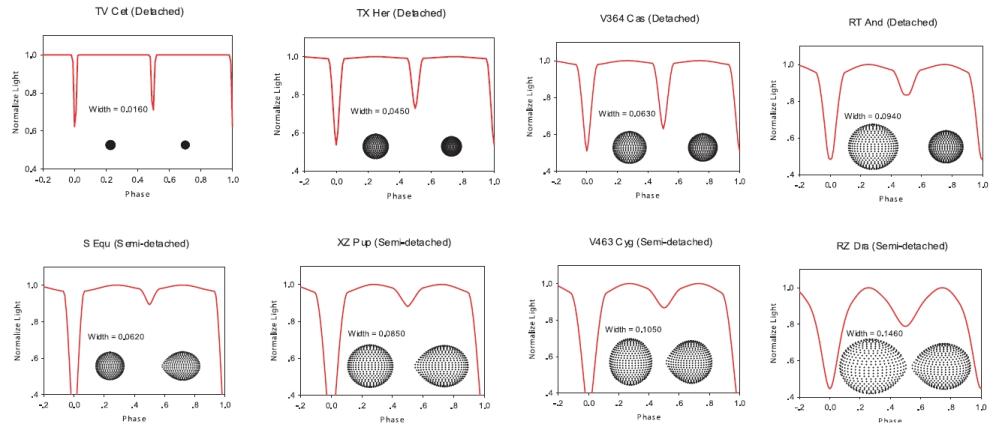
If the two stars are well separated, eclipses will be relatively narrow and there will be little or no brightness variation outside of the eclipses in these detached binaries. These stars are classified as Algol type eclipsing binaries or EA type for short. The primary and secondary eclipses will generally be V-shaped and of different depths; they will be separated by 0.5 in phase if the orbits are circular, but can be offset from this if the orbits are appreciably elliptical. If the two stars are closer, one may fill its equipotential surface (known as its Roche lobe) and so be distorted into an ellipsoidal shape. In these semi-detached binaries, there can be a smoothly varying brightness outside of the eclipses as the distorted star presents a changing cross-sectional area. The primary and secondary eclipses are again usually of different depths. These stars are classified as Beta Lyrae type eclipsing binaries or EB type for short. In practice there is a continuous distribution from EA type to EB type and it can often be difficult to distinguish between them, so in this project you will classify such objects as EA/EB type.
Here's an excellent diagram from Kang Young-Woon (Journal of Astronomy and Space Sciences Volume 27, Issue2, p75~80, 15 June 2010) which illustrates a range of detached and semi-detached eclipsing binaries.
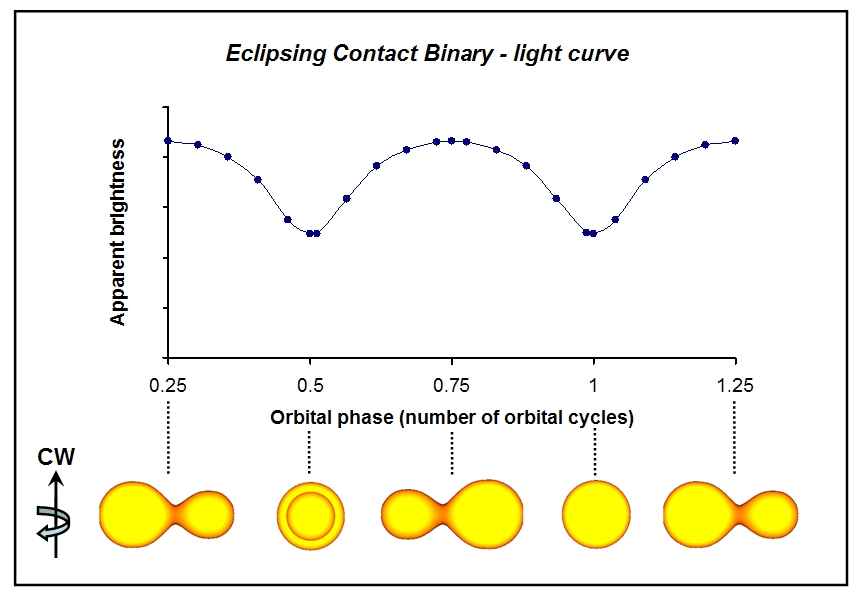
If the two stars are so close that both fill their Roche lobes, the two stars are in contact. Matter can flow between the stars which will therefore generally be at the same photospheric temperature. The stars will also be tidally locked such that their rotations match the orbital period. The primary and secondary eclipses will generally be of similar, sometimes identical, depth and there is a continuous brightness variation through the orbit. Sometimes one maximum will be brighter than the other, due to the presence of star spots on one of the stars - this is known as the O'Connell effect. Due to the proximity of the stars, their orbits will always be circular, so the two eclipses will be 0.5 apart in phase. These stars are classified as W Ursae Majoris type eclipsing binaries or EW type for short.
Here's an illustration of a contact binary and its associated lightcurve from BotRejectsInc (http://cronodon.com/SpaceTech/AstroTech.html).
Precise measurement of the eclipse times in eclipsing binaries can lead to measurements of how the binary orbital period is changing with time. If the period is increasing, the stars must be getting further apart; if the period is decreasing, the stars must be getting closer together and may eventually merge. If the period increases and decreases in a periodic manner, that may instead be due to a varying light travel time effect and indicate that the binary is itself in orbit with a third star in the system (see "Results").
Rotationally modulated stars
Stars displaying rotational modulation may be single stars with significant star spots on their surface. As such stars rotate, their apparent brightness will vary, so giving rise to a continuous, often sinusoidal, variation in brightness. There is a (poorly understood) relationship between a star's rotation period and its activity, so samples of rotational variables can be used to investigate this phenomenon.
Other rotational variables are close binary stars that do not eclipse one another, but are distorted into non-spherical (ellipsoidal) shapes by gravity due to their proximity. As such stars rotate around one another, they present a varying surface area to our line of sight and give rise to so-called ellipsoidal modulation in their folded lightcurves. These stars too will exhibit sinusoidal variations in their folded lightcurves.
In this classification project, both types will simply be referred to as rotators.
Multiply periodic stars
Multiply periodic stars are those which display more than one coherent periodic modulation in their lightcurve. These can include hierarchical multiple stellar systems, where a single point of light actually comprises (for instance) four stars composed of two eclipsing binary systems in orbit around their common centre of mass. The periods of both eclipsing binaries may be present in the lightcurve. We have previously identified the only known doubly eclipsing hierarchical quintuple star (see "Results") from SuperWASP data. Such hierarchical multiples can be used to investigate how stars form and evolve.
Another cause may be a pulsating star in an eclipsing binary system such that the lightcurve displays modulation at both a pulsation period and an eclipsing binary period. These systems are important as they allow dynamical stellar masses and radii to be measured and compared with the predictions of stellar pulsation models in the same system. We have previously identified a bright Delta Scuti pulsator in a semi-detached eclipsing binary with one of the largest pulsation amplitudes of any such system known (see "Results"). Around a hundred or so Delta Scuti stars are known in eclipsing binaries, but there are no known RR Lyrae stars in eclipsing binaries.