


Finished! Looks like this project is out of data at the moment!
Thank you for your efforts! We've completed our project! To browse other active projects that still need your classifications, check out zooniverse.org/projects
Education
Things to know about acoustics:
One mechanism in which energy transfer can occur is through waves. A mechanical wave is one in which a periodic disturbance, caused by some source, travels through a medium. The energy input from this source allows elements of the medium to be displaced from their equilibrium position, or resting point. Areas where displacement is greatest are referred to as antinode regions; points at which little to no displacement occurs are called nodes.
When a wave travels through a medium that is bounded, the wave can bounce back and create standing waves in the medium. Now the medium will want to vibrate at various rates based on how the waves bounce back. The rate at which a medium vibrates is referred to as frequency. Based on the stiffness, mass density, and length/area, a medium can be characterized by its natural frequencies. If these frequencies are all integer multiples of the lowest natural frequency, then they are called harmonics. When the system oscillates at one of these natural frequencies, the medium exhibits the largest displacements in its antinodal regions. These natural frequencies that lead to the highest amplitudes are called resonance frequencies.
Timbre, or quality of sound, of an instrument or medium is partially the result of the harmonics combining with different amplitudes. Similar timbres can be explained by a similar mix of amplitudes among harmonics. This can occur if two instruments produce their sound under comparable conditions. For example, the oboe and clarinet have almost identical timbres since they both have air columns that are excited by reeds. Drums, on the other hand, do not produce a sound with a definite pitch. This comes from the numerous frequencies that get reflected off a two-dimensional boundary. Since these frequencies are not related to each other as integer multiples, there is not a harmonic series that stands out in amplitude from the rest.
How it relates to our project:
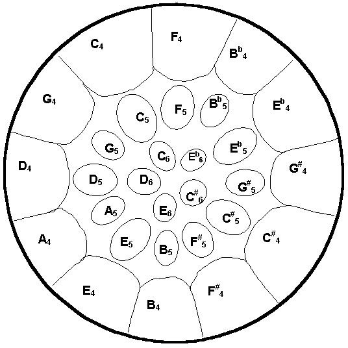
Most musical instruments have means of changing the pitch that is heard, which comes from the fundamental frequency. This includes changing the length of a string or air chamber to vary the natural frequencies or by having the notes separated, as is the case with instruments like the piano or marimba. With the steelpan, however, all of the notes are located on the same piece of metal. Each note region of the steelpan is tuned as to have its own fundamental frequency. When a note is struck, the note vibrates at its fundamental frequency. However, that note's frequency also correlates to harmonics of the notes surrounding it. This is why several notes will vibrate at the same resonant frequencies from only one note being struck.
In an investigation of the timbre of the steelpan, not only are the combination of harmonic frequencies from the struck note analyzed, but the vibrations of the neighboring notes also have to be considered. It is important to characterize the timing of the rise and fall of these coupled resonances along with their respective intensities in order to account for the unique quality of the steelpan's sound. That is what this project intends to accomplish! By classifying the frames of the ESPI recordings, the coupled resonances can be tracked and the steelpan's timbre can then be analyzed!!
Suggestions for teachers and other educators:
Our first suggestion is always to let your students explore on their own for a few minutes. Get them to get a feeling for how the process of making classifications works.
Math classes:
- What patterns do you notice?
- How many classifications will we need before we get our next retirement? (Can you write a computer program to simulate this?)
- How many classifications can you do in 10 minutes? If an entire classroom was working together at the same rate, how long would it take your class to make 1000 classifications?
Physics/Engineering classes:
- How many frames do you observe that exhibit second or third resonance behavior?