



Our test period for Galaxy Zoo Tags has completed! Thanks so much for your help. We'll update soon with the results of our experiment and the future of GZ Tags!
Research
The Science behind the Site
Welcome to Galaxy Zoo's latest incarnation. For more than a decade, we've asked volunteers to help us explore galaxies near and far, sampling a fraction of the roughly one hundred billion that are scattered throughout the observable Universe. Each one of the systems, containing billions of stars, has had a unique life, interacting with its surroundings and with other galaxies in many different ways; the aim of the Galaxy Zoo team is to try and understand these processes, and to work out what galaxies can tell us about the past, present and future of the Universe as a whole.
Our strategy is based on the remarkable fact that you can tell a lot about a galaxy just from its shape. Find a system with spiral arms, for example, and normally - but critically not always - you'll know that you're looking at a rotating disk of stars, dust and gas with plenty of fuel for future star formation. Find one of the big balls of stars we call ellipticals, however, and you're probably looking at a more mature system, one which long ago finished forming stars. The galaxies' histories are also revealed; that elliptical is likely to be the product of a head-on collision between two smaller galaxies, and smaller features such as warped disks, large bulges or long streams of stars bear testament to the complexity of these galaxies' lives.
Internal changes - what astronomers sometimes call 'secular' processes - can make a difference too. Each large galaxy has at its heart a massive black hole, and there is growing evidence that as matter falls towards these central black holes, it can have a dramatic effect on its surroundings; the matter is heated to enormous temperatures, glowing brightly in high-energy parts of the electromagnetic spectrum such as the x-ray. There might also be powerful jets of material launched from close to the black hole (though not, of course, from the black hole itself) at close to the speed of light. The combination of these jets and the effect of the radiation sometimes heats or expels gas from the galaxy, preventing - for a time, at least - further star formation.
A galaxy's surroundings matter too. At the centre of the Virgo cluster, our nearest large group of galaxies, mergers between systems are rare - held by the cluster's powerful gravitational grip, galaxies are moving too fast for more than brief encounters. In the emptiest parts of space, the density of galaxies is just too low for mergers to play a significant role, and so it's only on the outskirts of clusters or in small groups like our own Local Group that mergers currently play a significant part. It should come as no surprise, then, that we find different types of galaxies in different places, and this too must be taken into account.
Disentangling these effects, and many more, requires the largest possible samples of classified galaxies. It's not uncommon for us to need, for example, a large sample of red, barred, spiral galaxies that reside on the edges of clusters, and if we don't have a large sample to begin with there will be none left when we've narrowed the search. Modern surveys provide enough images - hundreds of thousands upon hundreds of thousands of them - but we still need people to sort them out by shape. That's where Galaxy Zoo comes in.
You can read much more about the scientific adventures Galaxy Zoo has already had on our blog, or in the papers we've written which are listed at Zooniverse.org/publications.
Where do the images come from?
Galaxy Zoo: JWST. Many different teams of scientists are using NASA’s latest space telescope, JWST to image galaxies so far away that they are back at the earliest time galaxies appear in the Universe.
To get Galaxy Zoo started on classifying (we hope eventually) all of the distant galaxies in JWST imaging, we are running a pilot with images from the Cosmic Evolution Early Research Science (CEERS) survey.

CEERS is using JWST to take extremely deep images of 100 sq. arcmin of the sky (which is about 1/8th the size of the Full Moon!). It is making use of JWST instruments called NIRCam, MIRI, and NIRSpec to obtain both images and spectra in this patch of sky. CEERS main goal is to demonstrate, test, and validate efficient extragalactic surveys with coordinated, overlapping parallel observations in a patch of sky which already has a lot of other multi-wavelength data (e.g. from HST).
Even though it’s mainly a test survey for future projects, CEERS will already provide images which can help us find out a lot about the type and number of galaxies at very high redshifts (z~9-13), look for early star formation, black hole growth and the assembly of bulges and discs in galaxies at z>3 and look for dust observed star formation and black hole growth at z~1-3.
Galaxy Zoo: Cosmic Dawn. These images come from the Hawaii Two-0 (H20) survey, part of the Cosmic Dawn survey that aims to understand how galaxies, black holes and dark matter co-evolve from the early Universe to the present. The Cosmic Dawn survey's ultra-deep imaging covers some of the darkest areas of the sky, allowing for the study of large numbers of galaxies going back to when the first of them formed within the first billion years after the Big Bang.
The galaxies here on Galaxy Zoo were imaged using the Hyper Suprime-Cam (HSC) camera on the 8.2 meter (27 feet) Subaru telescope on the summit of Mauna Kea in Hawaii. These galaxies are typically further away from us than those in previous incarnations of Galaxy Zoo, so their colours and resolution can appear a little different, generally appearing a little redder and blurrier.
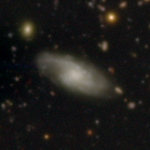
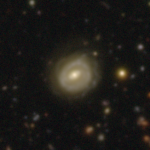
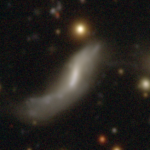
Galaxy Zoo: Cosmic Dawn is partly supported by the ESCAPE project, which aims to bring together the astronomy, astroparticle and particle physics communities to support open science, according to FAIR (Findable, Accessible, Interoperable and Reusable) principles.

ESCAPE - The European Science Cluster of Astronomy & Particle Physics ESFRI Research Infrastructures has received funding from the European Union's Horizon 2020 research and innovation programme under the Grant Agreement no. 824064.
Galaxy Zoo: DECaLS. These galaxy images come from the Dark Energy Camera Legacy Survey (DECaLS). Because it uses a larger telescope, DECaLS is 10 times more sensitive to light than the survey that supplied images to the first iteration of Galaxy Zoo, the Sloan Digital Sky Survey. That means that we can see more detail.
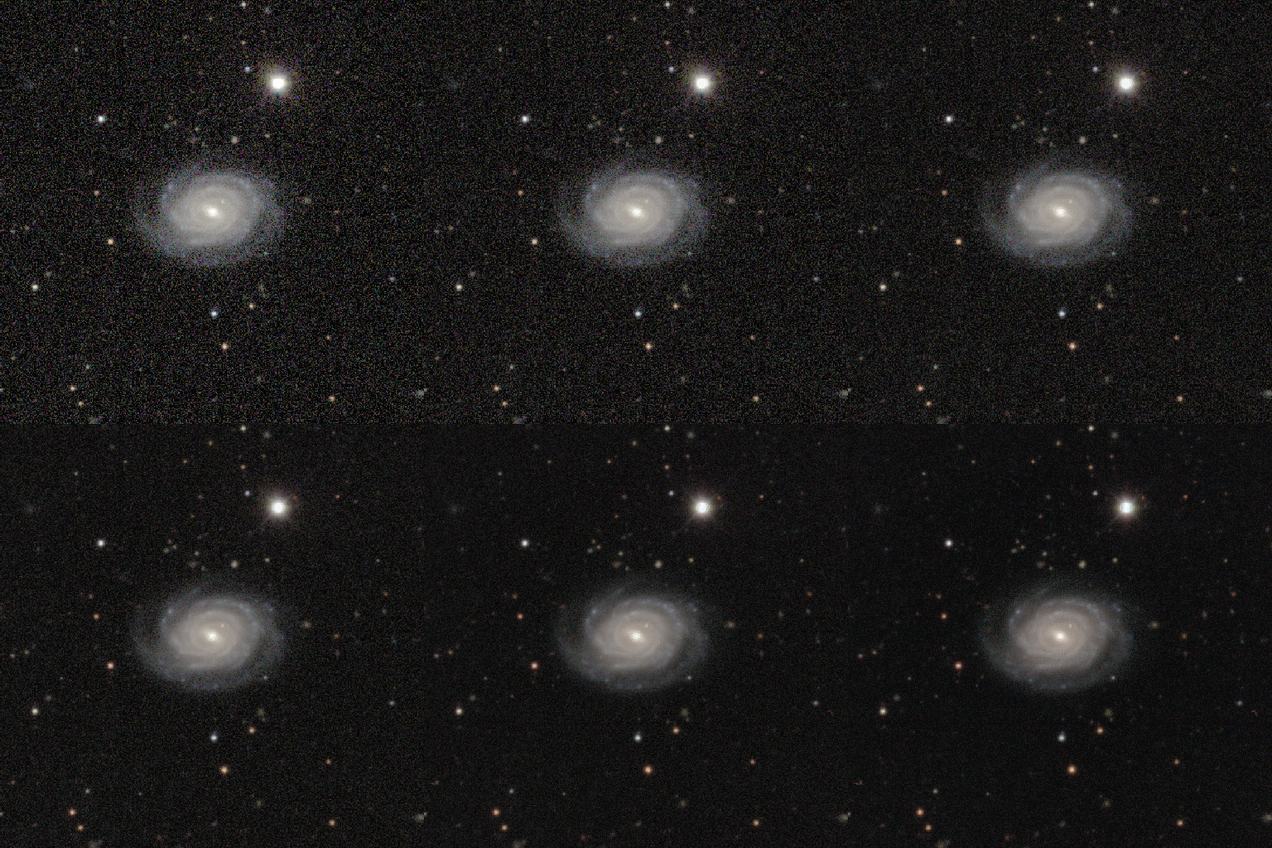
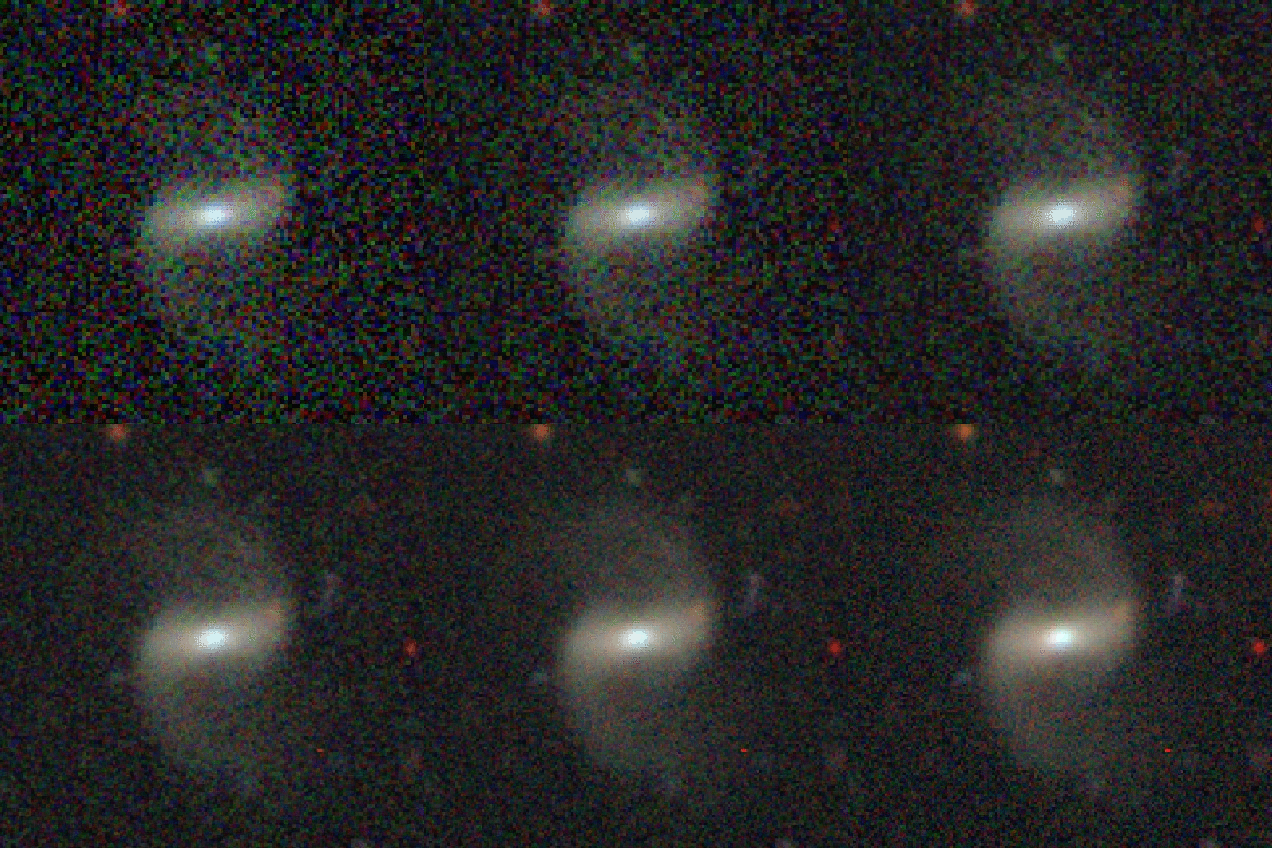
DECaLS is observing from the Victor Blanco 4 meter (13 feet) telescope in Chile. Check out this livestream from the observatory, including a view straight up the telescope. You can also browse the sky as imaged by DECaLS.
We also have a few images remaining from the Sloan Digital Sky Survey. By classifying these galaxies, you're helping scientists working on the MaNGA project compare how the shape of a galaxy affects the light spectra we see.
What's this 'Enhanced' mode all about?
In an effort to speed up classifications to cope with the large number of galaxies we expect to receive from new surveys, we've been working on ways to combine your classifications with those of machines, inspired by the idea that the combination of both automatic and human classification may be more powerful than either alone. If you choose the 'Enhanced' work flow, you will be much more likely to see the top 100 galaxies our galaxy-classifying robot thinks it needs help with in order to improve. All galaxies will be seen by at least a few volunteers to make sure we aren't missing anything. If you'd rather just see a random selection of available galaxies, choose 'Classic’.