



Finished! Looks like this project is out of data at the moment!
Welcome! Check out this short YouTube video for a quick introduction to the project.
6/19: Check out our latest announcement!
Research
Cracking the Case with Volunteers
In this project, we are studying plasma, a hot gas made of charged particles found in space. We are trying to tell the difference between "chaotic" plasma, which contains more energetic particles, and "peaceful" plasma. This is not easy. The Sun's behavior is always changing. It goes through an 11-year cycle, but it also varies from day to day. This makes the plasma we're trying to classify very messy. Things get even harder to tell apart during big solar events, like coronal mass ejections (CMEs), when the Sun’s magnetic field shifts and sends huge bursts of plasma into space.
We can look for clues that show whether the plasma is "chaotic" or "peaceful". But NASA’s Magnetospheric Multiscale (MMS) mission has collected more than ten years of data, and the conditions are always changing. It’s a huge job!
That’s where you come in. By helping classify these plasma regions, you can directly support space science. Humans are very good at spotting patterns, even when things look different each time. Together, we can find out when and where the plasma changes from "peaceful" to "chaotic". Your work will help scientists study unusual events and train machine learning models that may one day analyze data from the space environments of other planets.
This project is closely connected to the Space Umbrella Zooniverse project. Both projects use overlapping MMS data and imagery, and share members of the same research team. While Space Umbrella focuses on the broad boundary between Earth’s magnetic shield and the surrounding solar wind, this project zooms in on the region just outside that boundary to better understand how plasma behaves near the shock. Together, these efforts help build a more complete picture of Earth’s space environment.
The Scene of the Shock
The same processes that power the Sun also send out a steady stream of plasma. This stream is called the solar wind. When the solar wind reaches Earth, it meets our planet’s magnetic shield, called the magnetosphere. The magnetosphere is created by Earth’s magnetic field.
When the fast moving solar wind hits Earth’s magnetosphere, it is forced to slow down suddenly, creating a shock wave. It is like a sonic boom, but in space. Since space is so empty, the particles don't actually crash into each other. Instead, invisible magnetic forces act like a barrier that forces the solar wind to scatter and slow down. This process creates the boundary region, called the bow shock.
The disturbances from the shock can travel through the magnetosphere and sometimes affect Earth. They can cause space weather, such as auroras, and they can disturb satellites and power systems.
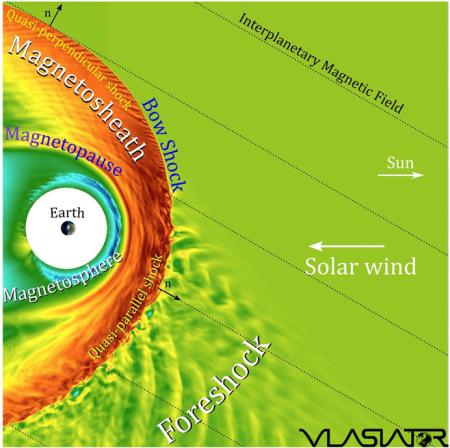
Visualization of the plasma environment near Earth showing portions of a bow shock that are quasi-perpendicular (or "peaceful") at the top and quasi-parallel (or "chaotic") at the bottom creating wavy patterns in the plasma. Image credit: European Commission 2021
Between the bow shock and the magnetosphere is a messy, turbulent area called the magnetosheath. It acts like a protective layer, or “sheath,” around the magnetosphere. The Sun has its own magnetic field, called the Interplanetary Magnetic Field (IMF). This field spreads across the whole solar system. It affects how the solar wind moves and how it interacts with the magnetosheath.
The IMF is not constant. It changes over time based on different streams of solar wind and solar activity that pass by Earth. These changes can happen over minutes, hours, or days. Because of this, the angle between the magnetic field and the bow shock is always shifting. This means the bow shock can behave differently at different times, even when a spacecraft passes through the same region.
The behavior of the shock depends on the angle of the IMF when it reaches the bow shock. If the magnetic field is mostly sideways compared to the shock, we call it quasi-perpendicular. If it is more lined up with the shock, we call it quasi-parallel. These names can sound confusing. They are not about how particles hit the shock. Instead, they only describe the direction (or angle) of the invisible magnetic field in comparison with the shock.
In the figure, the quasi-perpendicular shock (at the top) appears calmer and more uniform. In this project, we refer to it as the "peaceful" region. In contrast, the quasi-parallel shock is more turbulent and irregular (at the bottom surrounded by ripples). We call it the "chaotic" region for this project. Because the IMF direction changes over time, regions that appear "peaceful" at one time can become "chaotic" at another.
Why We're on the Case
By collecting many observations over time, we can track how these changing conditions affect Earth's bow shock and build a statistical picture of where and when “peaceful” and “chaotic” regions occur. This allows us to investigate how the bow shock processes energy and when it produces more energetic particles under different solar wind conditions.
There are three main reasons why this matters.
First, this boundary shows the moment when the solar wind meets Earth's magnetosphere. By studying it, we can see what happens to the untouched solar wind as it passes through this region. We can also learn how it changes before it reaches Earth. These changes can affect space weather, including things like temperature and pressure in near-Earth space.

Supernova also create shocks, but we cannot easily measure the plasma around them directly. Image credit: NASA/ESA/G. Bacon (STScI)
Second, collisionless shocks happen all over the universe wherever plasma interacts. By studying Earth’s bow shock, we can learn about the shocks that occur far outside our magnetosphere. In a way, Earth’s bow shock acts like a natural laboratory. It lets us study shocks in places where we cannot easily send spacecraft. By understanding Earth’s bow shock better, we also gain clues about shocks we know less about. These include the magnetospheres of distant planets, the leftovers of exploded stars (supernova remnants), and the plasma jets from black holes.
Third, when "chaotic" plasma dominates in the magnetosheath, more energy and waves can reach Earth's magnetosphere. This can contribute towards space weather effects that disrupt GPS signals, interfere with communications, and potentially threaten power grids. Scientists don't yet fully understand when the magnetosheath switches between "peaceful" and "chaotic" states or how those changes affect energy transfer to Earth. By classifying these plasma regions, you're helping build that missing picture.
Scene Footage from Space: The MMS Mission
NASA’s Magnetospheric Multiscale (MMS) mission uses four identical spacecraft. They fly in formation through Earth’s magnetosphere. The main goal of MMS is to study the fundamental physics of this complex plasma environment. Since its launch in 2015, MMS has crossed the bow shock boundary over 6,000 times.

Artist depiction of the four MMS spacecraft. Image credit: JHU/APL
As the spacecraft move through space, their instruments measure the plasma around them. They record things like temperature, energy, and the magnetic field. These measurements help scientists understand how plasma behaves and interacts in near-Earth space.
We focus on the magnetosheath just behind the bow shock because this is where we can see how the solar wind has changed after passing through the shock. The bow shock itself is very thin and does not last long. So a spacecraft cannot easily measure what happens right at that boundary. By studying the magnetosheath instead, we can observe what happens as this plasma slows down, mixes, and changes after passing through the shock as the solar wind moves toward Earth.
This work is funded by NASA. Find other information about NASA Volunteer Projects here.
