


Research
Overview
This Zooniverse project is part of the work of the Treatied Spaces Research Group, and forms part of 'Brightening the Covenant Chain', a large funded research project concerned with diplomacy between the Haudenosaunee and the British Crown in territories now occupied by the United States and Canada.
Mapscapes is a project about recovery. Its aim is to produce a new map of the Northeast that puts the place names of the Haudenosaunee back in their original positions. Our focus is present day New York, the location of the villages and towns of the Six Nations. This is the focus of the 'Morgan' workflow. It is focused on the map included in Lewis Henry Morgan's League of the Ho-De-No-Sau-Nee, originally published in 1851. Morgan is a controversial figure, mainly for his suggestion that social groups evolved from a state of 'savagery' to 'barbarism' on their way to civilization. His work with Indigenous Americans informed this theory. Our use of Morgan in no way endorses this; our main interest is in the detailed map that accompanied the larger text, and the Appendix of Haudenosaunee and other place names likely compiled by Ely Parker. The second workflow is based on a Public Report compiled by the Susquehanna River Basin Commission, which is a textual listing of Indigenous place names.

Workflow 1: Mapping Indigenous Lands and Places
The rapid development of GIS, data visualisation and research software has generated a number of projects and initiatives concerned with mapping Indigenous spaces. A huge number of maps were produced by Europeans as they sought to establish their territorial claims in the 'new world'. Some of these omit the presence of Indigenous peoples, while others - like John Mitchell's map of the British and French dominions - captured Native American places (and some placenames) in detail. Many modern digital projects, this one included, engage in 'counter-mapping' - the use of cartographic techniques to correct maps that are products of certain power relations. There are a number of these kinds of projects:
- The Decolonial Atlas
- Canada - Stories from the Land
- Reclaiming Indigenous Placenames
- Alaska Native Placenames Project
- Coming Home to Indigenous Placenames
The Map
This curious map, so quaint in topography, and so generally in harmony with the general knowledge of the period of its date, was found among the old papers of the late John Mountpleasant, my husband, one of the most progressive and distinguished of the chiefs of the Tuscaroras. I can give no clew to its early history, except that my brother, General Ely S. Parker, valued it when he assisted Morgan in the preparation of his history of the Six Nations in 1851, 40 years ago.
- Mrs Caroline Mountpleasant, quoted in Thomas Donaldson, Indians: The Six Nations of New York (1892), p.21
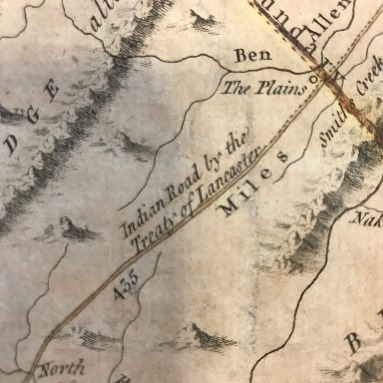
The map (below) that accompanied Morgan's text is scarce, with only a handful of copies held by libraries and archives, such as the Library of Congress. The map shows hand-coloured areas of tribal and linguistic sovereignty, the occupancy of land, villages, towns and trails. It has a key to help with pronunciation of Ho-De-No-Sau-Nee-Ga words, a number of which were modified for use as place names. Those with knowledge of historic pronunciation styles in upstate New York will be of particular value to this project as it attempts to learn more about these names and their provenance.
Lewis Henry Morgan was a wealthy Rochester attorney whose works retain a central place within American anthropology. His research on the Haudenosaunee was made possible by the help of the outward-looking Parker family of Tonawanda. William Parker served with a group of his people allied with the Americans in the War of 1812 and then married Elizabeth, a niece of the Seneca leader Jimmy Johnson (Sose-há-wä), grandson (in Seneca kinship terminology) of the prophet and leader Handsome Lake. Morgan developed a close relationship with William and Elizabeth’s son, Ely S. Parker.
The book, League of the Ho-dé-no-sau-nee, or Iroquois is often held up as marking the beginning of American anthropology. Morgan was ahead of his time in attempting to engage with Indigenous societies on their own terms. With considerable intellectual daring, he tried to understand what had underpinned the development of humankind across deep time. Morgan also worked to help Ely Parker and other Indigenous peoples at multiple levels. However, Morgan’s researches led to wholly erroneous conclusions. His book Ancient Society (1877) argued that Indigenous peoples were destined to vanish and that they were somehow “behind” within a constructed schema of human social evolution within which Caucasians were at the forefront. In many ways, this quotation below from Morgan sums up both the thinking of his time and his contribution to debate:
A more fatal mistake was never made than to suppose the Indian deficient in brains. He is as sound headed as any species of man on the earth. His notions of the objects and ends of life are different from ours. This is the principal fact we have occasion to recognize, and we must deal with him accordingly.
- Lewis Henry Morgan, “Unknown letter”, quoted in Joy Porter, To Be Indian: The Life of Iroquois-Seneca Arthur Caswell Parker (University of Oklahoma Press, 2001), p.37

Workflow 2: Waterbody and Placenames
This workflow asks users to classify tabular data from a report on Indigenous place names in the Susquehanna River Basin, which sits on the western edges of Iroquoia. The report includes a map (below) that positions each place name, and the tables provide a translation of the meaning of the name.
