


Research
Understanding the Hidden Lives of Whales
Opening new doors to our understanding of whales: Today, whales and dolphins are legally protected from exploitation in most countries. But they were hunted for centuries, hunted with rapacious intensity from the early 1900's to the 1970’s. This left a world of oceans nearly empty of their largest inhabitants. How are they recovering? What has changed as a result? With climate change and ever increasing competition for ocean resources, will they be able to return to their former abundance?
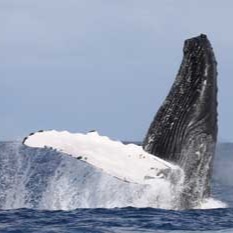
Snapshots at Sea opens a novel approach to answering these and many more questions; with your help we can find and identify hidden elements in the lives of humpback whales around the world through images from scientists, naturalists and public contributors. The images here come to us via Happywhale.com, where we ask photographers worldwide to share images to extract their scientific value. ‘Opportunistic’ data like this accounts for the majority of whale sightings worldwide. We use machine learning based AI image recognition to identify individual whales, like this case:

What have we found? In the North Pacific Ocean, we have identified the majority of living humpback whales, resulting in the first continuous population model ever built for a large population of whales. And we have found individuals migrating across unexpected long distances -- see below for some of the publications that have resulted from our work.
Migratory patterns mapped in Happywhale:

Supporters
We are grateful for the support from EY, for Microsoft employee volunteers participation, and all the organizations contributing to this project:


Partial list of publications these images have contributed to:
Acevedo, J., Capella, J., Cheeseman, T., Monnahan, C.C., Southerland, K., Acuña, P., Aguayo-Lobo, A., 2021. First evidence of interchange of humpback whales (Megaptera novaeangliae) between the Magellan Strait and Antarctic Peninsula feeding grounds. Polar Biol. 1–7. https://doi.org/10.1007/s00300-021-02827-2
Acevedo J, Aguayo-Lobo A, Beeman P, Cheeseman T, Olavarría C (2022) From the Antarctic Peninsula to eastern Australia: the longest migration of a humpback whale through the South Pacific Ocean. Mamm Biol 2022 1–6. https://doi.org/10.1007/S42991-021-00195-2
Barlow J, Cheeseman T, Trickey JS (2021) Acoustic detections of beaked whales, narrow-band high-frequency pulses and other odontocete cetaceans in the Southern Ocean using an autonomous towed hydrophone recorder. Deep Sea Res Part II Top Stud Oceanogr 104973. https://doi.org/10.1016/J.DSR2.2021.104973
Cheeseman T, Southerland K, Park J, Olio M, Flynn K, Calambokidis J, Jones L, Garrigue C, Frisch Jordán A, Howard A, Reade W, Neilson J, Gabriele C, Clapham P (2021) Advanced image recognition: a fully automated, high-accuracy photo-identification matching system for humpback whales. Mamm Biol 2021 1–15. https://doi.org/10.1007/S42991-021-00180-9
Cheeseman, T., Johnson, T., Southerland, K., & Muldavin, N. (2017). Happywhale: Globalizing Marine Mammal Photo Identification via a Citizen Science Web Platform. Report to the International Whaling Commission.
Cheeseman, T., & Southerland, K. (2016). Happywhale.com: A Web-based Citizen Science Marine Mammal Photo Identification Platform. Report to the International Whaling Commission.
Cheeseman, T., & Southerland, K. (2018). Happywhale Progress Report 2017-2018. Report to the International Whaling Commission.
Curtis KA, Calambokidis J, Audley K, Castaneda MG, De Weerdt J, García Chávez AJ, Garita F, Martínez-Loustalot P, Palacios-Alfaro JD, Pérez B, Quintana-Rizzo E, Ramírez Barragan R, Ransome N, Rasmussen K, Urbán J, Villegas Zurita F, Flynn K, Cheeseman T, Barlow J, Steel D, Moore J, Megaptera P, Salvador E, Ecoturismo Y (2022) NOAA Technical Memorandum NMFS Abundance Of Humpback Whales (Megaptera novaeangliae) Wintering In Central America And Southern Mexico From A One-Dimensional Spatial Capture-Recapture Model. https://doi.org/10.25923/9cq1-rx80
Darling JD, Audley K, Cheeseman T, Goodwin B, Lyman EG, Urbán RJ (2022) Humpback whales (Megaptera novaeangliae) attend both Mexico and Hawaii breeding grounds in the same winter: mixing in the northeast Pacific. Biol Lett. https://doi.org/10.1098/RSBL.2021.0547
De Weerdt, J., Ramos, E. A., & Cheeseman, T. (2020). Northernmost records of Southern Hemisphere humpback whales (Megaptera novaeangliae) migrating from the Antarctic Peninsula to the Pacific coast of Nicaragua . Marine Mammal Science, (January), 1–7. https://doi.org/10.1111/mms.12677
Félix, F., Abras, D., Cheeseman, T., Haase, B., Figueiredo Santos, J., Marcondes, M., Southerland, K., Acevedo, J. (2020). A New Case of Interoceanic Movement of a Humpback Whale in the Southern Hemisphere: The El Niño Link. Aquatic Mammals 46(6):578-583. https://doi.org/10.1578/AM.46.6.2020.578
Garrigue, C., Derville, S., Bonneville, C., Baker, C., Cheeseman, T., Millet, L., Paton, D., Steel, D. (2020). Searching for humpback whales in a historical whaling hotspot of the Coral Sea, South Pacific. Endangered Species Research, 42, 67–82. https://doi.org/10.3354/esr01038
Jackson, J., Kennedy, A., Moore, M., Andriolo, A., Bamford, C., Calderan, S., Cheeseman, T., Gittins, G., Groch, K., Kelly, N., Leaper, R., Leslie, MS., Lurcock, S., Miller, BS., Richardson, J., Rowntree, V., Smith, P., Stepien, E., Stowasser, G., Trathan, P., Vermeulen, E., Zerbini, AN., Carroll, EL. (2020). Have whales returned to a historical hotspot of industrial whaling? The pattern of southern right whale Eubalaena australis recovery at South Georgia. Endangered Species Research, 43, 323–339. https://doi.org/10.3354/esr01072
Marcondes MCC, Cheeseman T, Jackson JA, Friedlaender AS, Pallin L, Olio M, Wedekin LL, Daura-Jorge FG, Cardoso J, Santos JDF, Fortes RC, Araújo MF, Bassoi M, Beaver V, Bombosch A, Clark CW, Denkinger J, Boyle A, Rasmussen K, Savenko O, Avila IC, Palacios DM, Kennedy AS, Sousa-Lima RS (2021) The Southern Ocean Exchange: porous boundaries between humpback whale breeding populations in southern polar waters. Sci Reports 2021 111 11:1–12. doi: 10.1038/s41598-021-02612-5
Marcos D, Kierdorf J, Cheeseman T, Tuia D, Roscher R (2022) A Whale’s Tail - Finding the Right Whale in an Uncertain World. 297–313. https://doi.org/10.1007/978-3-031-04083-2_15
Martien KK, Taylor BL, Archer FI, Audley K, Calambokidis J, Cheeseman T, De Weerdt J, Jordán AF, Martínez-Loustalot P, Ortega-Ortiz CD, Patterson EM, Ransome N, Ruvelas P, Urbán Ramírez J, Villegas-Zurita F (2021) NOAA Technical Memorandum NMFS EVALUATION OF MEXICO DISTINCT POPULATION SEGMENT OF HUMPBACK WHALES AS UNITS UNDER THE MARINE MAMMAL PROTECTION ACT. https://doi.org/10.25923/nvw1-mz45
Peres dos Santos R, Martins R, Chaiko A, Cheeseman T, Jones LS, Wenzel FW (2022) First humpback whale (Megaptera novaeangliae) re-sighting between Azorean waters and the Barents Sea (Murman coast, northwestern Russia). Polar Biol 2022 1–5. https://doi.org/10.1007/S00300-021-02998-Y
Tackaberry J, Dobson E, Flynn K, Cheeseman T, Calambokidis J (2022) Low Resighting Rate of Entangled Humpback Whales Within the California, Oregon, and Washington Region Based on Photo-Identification and Long-Term Life History Data. Front Mar Sci 0:2092. https://doi.org/10.3389/FMARS.2021.779448
Taylor BL, Martien KK, Archer FI, Audley K, Calambokidis J, Cheeseman T, De Weerdt J, Jordán AF, Martínez-Loustalot P, Ortega-Ortiz CD, Patterson EM, Ransome N, Ruvelas P, Urbán Ramírez J EVALUATION OF HUMPBACK WHALES WINTERING IN CENTRAL AMERICA AND SOUTHERN MEXICO AS A DEMOGRAPHICALLY INDEPENDENT POPULATION. https://doi.org/10.25923/sgek-1937
Violi B, Verga A, Jones LS, Calogero G, Soldano G, Cheeseman T, Wenzel FW (2021) A Wanderer in the Mediterranean Sea: The Case of a Humpback Whale (Megaptera novaeangliae) from the West Indies. Aquat Mamm 599–611. https://doi.org/10.1578/AM.47.6.2021.599