


Finished! Looks like this project is out of data at the moment!
Absolutely brilliant that we have completed the first categorisation. Now on to the next stage 😃 Be sure to check out this workflow on the mobile app! Also note - this project recently migrated onto Zooniverse’s new architecture. For details, see here.
Education
EfA not only conducts behavioural research on the elephants in the MPNP, but also addresses the socioecological aspects of elephant conservation. The Boteti River forms the interface between the community lands to the west and the national park to the east, as wildlife, domestic animals, and people are brought into close proximity at this shared resource. This lack of a buffer zone has led to some of the highest levels of human-wildlife conflict in Botswana, with elephants and lions considered to be the main perpetrators/at-risk wildlife. Since male elephants are more likely to engage in crop raiding than females, and more than 70% of the human population in the area are engaged in subsistence farming, this conflict is a large socioeconomic issue in the area.
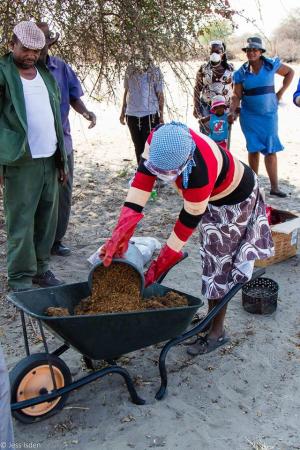
Therefore, we here at EfA are applying our knowledge of the elephant population to tailor human-elephant conflict mitigation strategies to the specific situation found in the Boteti District. Through our Community Coexistence Project, a three-year project funded by the Good Planet Foundation, we are engaging with farmers in the area to try to reduce incidences of elephant crop-raiding. We hold community-wide workshops, teach people how to use chili pepper to deter elephants, and are testing a number of other mitigation techniques such as flashing solar beacons. Through our school's education programme we also work with the Environmental Clubs at two local primary schools that border the MPNP, with the aim of inspiring the next generation of environmental champions.
Interested in learning more about wildlife ecology and behavior?
Check out our Snapshot Safari educational materials, perfect for day camps, informal classroom settings, and students who wish to extend their knowledge of the African savannah.
Want to learn more about Snapshot Safari parks and conservation history?
Explore our timeline at https://www.tiki-toki.com/timeline/entry/979721/Snapshot-Safari/
Would you like to use our data for research?
One of the primary goals of Snapshot Safari is to generate spatial and temporal data on the dynamics of numerous African wildlife species living under varying ecological conditions that will be useful to scientists across the globe. If you are a student or researcher interested in using the camera trapping data from our project to test new and exciting hypotheses, email Sarah Huebner at huebn090@umn.edu to tell us more about your project. Please include the names of all researchers, a brief abstract, and a list of the Snapshot sites from which you'd like data.