


Finished! Looks like this project is out of data at the moment!
Thank you for your efforts! We've completed our project! To browse other active projects that still need your classifications, check out zooniverse.org/projects
FAQ
Am I doing it right?
You are probably doing great! However, if you are unsure about what to do, go through the tutorial, look through the field guide and classify a few images. As with all the citizen science projects, practice makes perfect!
Can I go back and change my answer?
If you miss an asteroid in the image by accident, or hit “Done” too soon, don't worry! It is important to remember that many people will classify every image and we combine all the answers before creating a final catalogue. This helps make up for any individual errors there might be on the way. The more people classify an image, the better the result will be.
Who will benefit from this work?
This project is run by scientists at the European Space Agency's ESAC Science Data Centre. The asteroid positions marked by the classifiers will be combined into the best positions, and the coordinates and the time the image was taken will be communicated to the IAU Minor Planet Center, who will compute the orbit and will identify the asteroid based on their database. If the position is offset compared to their predicted position, they will update the database.
In case multiple asteroids are present in the images, they will cross-match all the positions with their database, and identify the asteroid. In case it is not in their database, and it is not an image artifact, it will be reported as a new asteroid discovery, so the project has the potential of new serendipitous discoveries!
Why is it important to know the position of asteroids?
Science
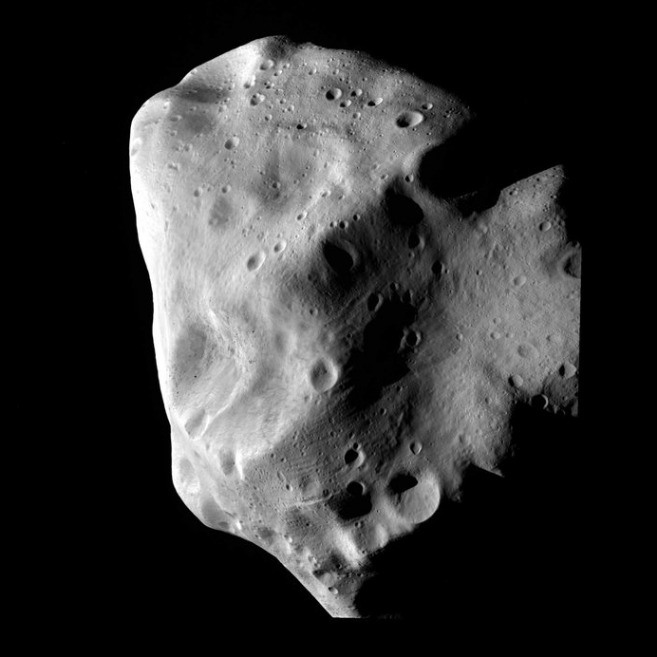
Asteroids come in all shapes and sizes. Most of them are irregular and range in size between tens of meters to hundreds of kilometres (the largest is Ceres, 900 km in diameter). More than ten thousand asteroids have so far been discovered, and the vast majority of them lie in the region between the orbits of Mars and Jupiter, in what is known as the Main Asteroid Belt. This leftover debris from the early days of the Solar System is found mainly in that region because the large gravitational pull of Jupiter prevented the formation of another planet nearby. Because of gravitational interactions, some of the asteroids can become stray and change their orbits, occasionally intersecting the orbits of other planets. Asteroids coming close to the Earth are known as near-Earth objects. Knowing the orbits of asteroids, the scientists can predict their future positions and follow them up with further observations to characterise their shapes and masses, and can work out their composition and internal structure, whether they are made of solid rock and heavy metals or light, icy and made of rubble-piles of rock. Asteroids are important clues to study the conditions at the beginning of our Solar System. You can find out more about asteroids here.

[Credit: Created from a montage by Emily Lakdawalla; Data from NASA / JPL / JHUAPL / UMD / JAXA / ESA / OSIRIS team / Russian Academy of Sciences / China National Space Agency (CC BY-SA 4.0)]
Space debris risk
It is important to know the exact position of asteroids because, as they orbit around the Sun along elongated orbits, their paths might cross the Earth's orbit. Sometimes they can come very close to Earth itself. For example, in 2018 three asteroids with sizes of about 100 m approached our planet within one lunar distance (about 300,000 km), and were discovered only a few days before the closest approach. This is one of the reasons why it is important to follow them up and improve the orbit determination to calculate if, when and where the orbit of an asteroid might intersect with Earth at some point in the future. This way we might be able to prevent a potential danger to Earth!
Another example is the entry of a 20-m asteroid in Earth's atmosphere on 15 February 2013, known as the (Chelyabinsk meteor). Stray asteroids might impact the Earth and form craters such as the Meteor Crater in Arizona, 1.2 km across. Many scientists believe that a 10 km-wide object caused the extinction of dinosaurs when it struck the Gulf of Mexico 65 million years ago.
