



Finished! Looks like this project is out of data at the moment!
Thank you for your efforts! This project is no longer active. To browse other active projects that still need your classifications, please check out zooniverse.org/projects
Research
Surfing spacetime
They are ripples in the fabric of spacetime. They are cosmic messengers probing the dark Universe.
They are gravitational waves.
Predicted more than a century ago by Albert Einstein, gravitational waves are bringing new information on the most violent events in the cosmos, such as the merging of black holes or neutron stars.
Gravitational waves were first detected on the 14th of September, 2015, when the twin detectors of the Laser Interferometer Gravitational wave Observatory (LIGO) were able to catch the tiny stretches in spacetime produced by two black holes that merged in a galaxy more than a billion light-years away from us.
It was just the beginning. In fact, that first gravitational wave signal, labeled GW150914, opened a new era in the study of the cosmos. In August, 2017, Advanced Virgo, the largest gravitational wave detector in Europe, joined LIGO in forming the most advanced and sensitive network of gravitational wave observatories.
With the GWitchHunters project you will help scientists to make gravitational wave detectors more sensitive and to listen to new sources in the Universe.
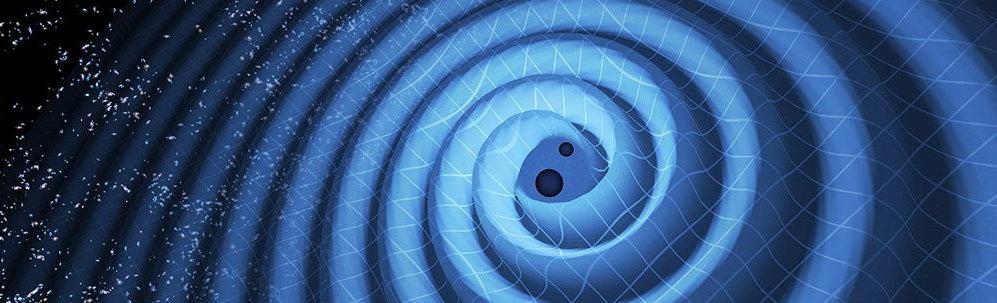
(Artistic Representation of gravitational waves from merging black holes. Credits: LIGO/T. Pyle)
Listening to the cosmos
To date, Advanced LIGO and Virgo have successfully completed three observing campaigns, or observing runs. The first observing run, called O1, lasted from the 12th of September, 2015, to the 19th of January, 2016, and was carried out by LIGO detectors only.
The second run, O2 (30 November, 2016 – 25 August, 2017), began with the two LIGO detectors and was completed with a three-detector network, as Virgo joined in August, 2017. The third observing run (O3) started on the 1st of April, 2019, and lasted one year, ending early, on the 27th of March, 2021, because of the COVID-19 pandemic.
During O1 and O2 a set of 11 signals were detected, 10 from the merging of binary black holes and one from the merger of two neutron stars, detected on the 17th of August, 2017. Ground based and space telescopes also observed a luminous emission associated with this event, called GW170817, thus marking the first combined observation of light and gravitational waves from a cosmic source, a milestone in multi-messenger astronomy.
During the first half of O3, known as O3a, 39 new events were detected, increasing the total number of detections, which were published in the second Gravitational Wave Transient Catalog (GWTC-2).
How to detect gravitational waves?
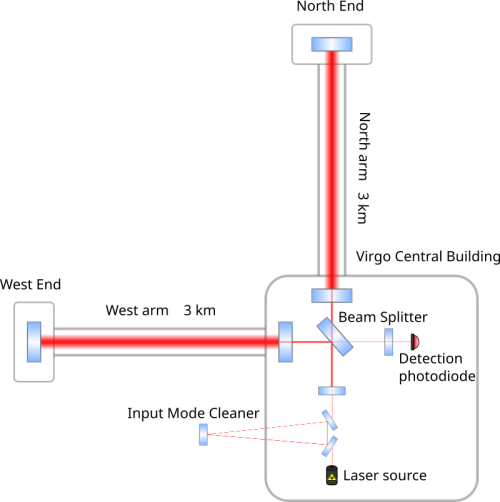
Modern gravitational wave detectors are an updated and much bigger version of the Michelson interferometer, an instrument that allows precise measurements exploiting the interference of two beams of light. Advanced Virgo and LIGO use a source of laser light that is divided into two orthogonal paths by a semi-reflective mirror called a Beam Splitter, and then reflected back by two End Mirrors, placed at the end-points of the two km-long arms, to be recombined by the Beam Splitter and sent to the detector.
Since light consists of electromagnetic waves, at the detection photodiode we can observe their interference pattern due to the superposition of the waves. If the two arms are exactly equal in length, the waves of the two beams are opposite and cancel one another out, thus no light is visible. The passage of a gravitational wave stretches spacetime, introducing a differential strain that changes the lengths of the two arms. The interference is no longer destructive and some light is visible at the detector, thus indicating the passage of a gravitational wave.
This is the basic principle of gravitational wave detection. In reality, of course, detectors like Virgo are much more complicated, as you can see in the picture below.
Gravitational wave signatures
By studying the output of laser interferometers, scientists can reconstruct the intensity and frequency of gravitational waves.
For each of these gravitational wave signals, we can build a spectrogram, i.e. an image that represents how the frequency, or "pitch", of the gravitational wave signal evolves with time. Typically, the signal from two merging black holes or neutron stars becomes louder with time, while shifting toward higher frequencies. If we translate this to an audio signal, it will resemble the chirp of a bird. We can easily recognise the signature of the chirp in the data of GW170814 (see Figure below), the first event to be detected by the three-detector network of LIGO and Virgo.

(Spectrogram of GW170814, where it is possible to see the typical "chirp" signal. Adapted from Abbott et al 2019, PRL 119, 141101)
Buried in the noise
But why do the GW170814 chirps look so different from one another? Well, it all depends on the sensitivity of each detector in the network, which depends on the quantity of background noise. This noise can reduce the ability of a detector to detect real astrophysical signals.
Understanding the behaviour of the detectors and their noise is a crucial part of the journey towards a systematic improvement of the detection performance and of the science outcome.
Here is where GWitchHunters comes to play!
In this project, you will help scientists to study and reduce the noise in the gravitational detectors, with the goal of improving their sensitivity and catching more gravitational waves.
A particularly detrimental kind of noise is what is known as transient noise. This is particularly difficult to study, especially when it appears for very short periods of time - meaning they can last for less than a second - and are called glitches. The first step to removing them is to understand their properties and to classify them according to their spectrograms, since we think that similar glitches share the same noise source.
As you can see from the figure below, glitches can have very complex morphology and can be very diverse. Glitch classification is very important and is the main task of the Gravity Spy citizen science project.
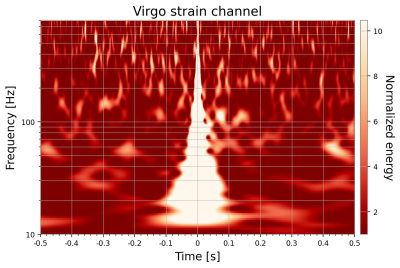
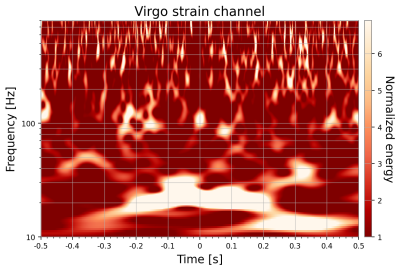
(Example of spectrograms associated to two different types of glitches observed in Advanced Virgo)
People can make a difference
Due to the complexity and diversity of the possible shapes that these glitches can take, it is very difficult to design an algorithm capable of recognising and distinguishing them. However, we the people are trained from the very first years of school to accomplish this task. Consider for example the ability that we have developed to read hand-written letters by different people or text printed in different fonts, some of them quite fancy. Or to recognize animals and plant species from some of their distinguishing features. Here, for the characterization of detector noise, we are asked to accomplish a similar task.
It is quite difficult to formally explain how we proceed in our evaluations; what we focus on first and what matters most for our decisions. Likewise, it is not a simple task to program a computer to reproduce this. What really matters for us is the experience that we have gathered in years of life, examples and decisions taken. Now we are able to decipher even the worst handwriting and spot the species of the fanciest looking bug. Then, why entrust the development of our instruments and knowledge to machines, when we have plenty of people eager to collaborate and well known to be more expert and capable?
Become a noise hunter!
Glitches are only one kind of possible noise, and their classification is only the first step in the "hunt" to understand the noise in gravitational wave detectors. We not only record the passage of gravitational waves in a main strain channel but also constantly monitor the status of detector subsystems and the surrounding environment. This is done by hundreds and thousands of sensors and controls, the data of which is recorded in many auxiliary channels. We can inspect what's going on in the main strain channel and in the auxiliary ones at the same moments in time, looking for correlations and for similar shapes in the spectrograms.
Similarities with particular auxiliary channels can help to suggest the origin of the noise and might point to its source being in a particular subsystem of the detector or in some environmental phenomenon.
In GWitchHunters we will guide you through different levels, where you will learn step-by-step how to identify and classify the noise in gravitational wave detectors, as well as finding which auxiliary channels contribute to the noise that we observe in the strain channel.
You will also find some special Mobile Challenges, which you will be able to play from the Zooniverse app for mobile devices.
So, it's almost time now...are you ready to become a GWitchHunter?