


Finished! Looks like this project is out of data at the moment!
Thank you for all of your hard work! Phase 2 of Star Notes is now complete! For more information see our Talk Thread.
Research

Harvard College Observatory, H. (1918). [Observatory Staff in "paper Doll" Pose, (in Line Holding Hands) Panoramic Photograph Ca. 1918].
Background
Project PHaEDRA is an initiative by the Wolbach Library at the Harvard-Smithsonian Center for Astrophysics. PHaEDRA stands for Preserving Harvard’s Early Data and Research in Astronomy. The goal of the project is to catalog, digitize, transcribe, and create metadata for over 2,500 notebooks produced by early 20th century women computers at the Harvard College Observatory. These women made advancements and discoveries in the field of astronomy, many of which are still used today. We hope that this project will make this remarkable set of items accessible in the future. Modern researchers will be able to connect these notebooks with the physical glass plate photographs that the astronomers used to make their discoveries.
About the Astronomers
Cecilia Payne-Gaposchkin was a British-American astronomer who worked closely with the Harvard Computers. Payne completed her PhD in 1925, with a dissertation titled Stellar Atmospheres: A Contribution to the Observational Study of High Temperature in the Reversing Layers of Stars. She discovered the chemical composition of stars and, in particular, that hydrogen and helium are the most abundant elements in stars. Her work was of fundamental importance in the development of the field of stellar atmospheres, and her observations and analyses of variable stars laid the foundation for their use as indicators of galactic structure. You can read more about her education and work with stellar spectra.
Muriel Mussells Seyfert was born in 1909. She worked as an astronomer and research assistant at the Harvard College Observatory, where her discoveries included ring nebulae in the Milky Way. She continued her work as an astronomer at the Vanderbilt Dyer Observatory in Brentwood, Tennessee after marrying Dr. Carl K. Seyfert, the founder and director of the observatory. She was an avid painter and kept an art studio in the observatory residence. She died in 1997 at the age of 88.
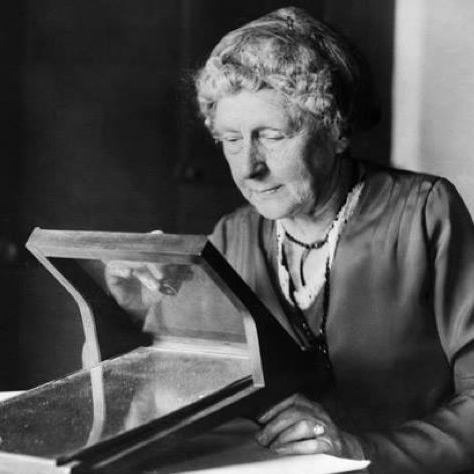
Annie Jump Cannon worked at the Harvard College Observatory from 1896-1940. She attended Wellesley College in Massachusetts, where she studied physics and astronomy. She became a computer at the Harvard College Observatory. She developed a star classification system that is still used today. According to her classification system, stars can be either O, B, A, F, G, K or M, with O being the hottest stars and M being the coolest. In 1911 she was named Curator of Astronomical Photographs at at the Harvard College Observatory. During her career, she had also discovered 300 variable stars, five new stars, and one spectroscopic binary. She was the first female recipient of an honorary doctorate from Oxford University.
Star Notes
Star Notes is a new initiative for Project PHaEDRA with the goal of linking the notebooks back to their original source material: 500,000 glass plate photographs representing the first ever pictures of the visible universe. Each glass plate is identified with a unique "plate number." The Harvard Computers would usually record which glass plates they were researching by noting the plate numbers in their notebooks. We need volunteers on Zooniverse to find and transcribe these handwritten plate numbers. This information will improve our understanding of the history of the Harvard Computers and the Astronomical Photographic Plate Collection. It will also will enhance understanding of the individual plates themselves being digitized through DASCH (Digital Access to a Sky Century @ Harvard) and allow researchers in Time Domain Astrophysics to better understand how the Universe is evolving.

Image of a glass plate from the Harvard College Observatory Astronomical Photographic Plate Collection.