


Finished! Looks like this project is out of data at the moment!
Thank you for your efforts! This project's classification effort is complete! To browse other active projects that still need your classifications, check out zooniverse.org/projects
Research
The Challenge
Fast Radio Bursts, aka 'FRBs' or 'furbies', are massive bursts of radio energy we see from across (half) the universe. We call them Fast Radio Bursts because that's what we see - a brief millisecond 'burst' of energy in radio light. These things are really bright - in a millisecond, they put out about as much energy as our own Sun in 7 hours!
What are they? We don't really know! They could be from hyper-magnetized neutron stars, neutron stars collapsing into black holes, sparks from cosmic strings, or maybe something else entirely.
Every new observation tells us a little more about what's really happening. We need to find these bursts!
Sounds easy right? Just look for bright bursts of radio. Unfortunately, we humans also like to make lots of really bright, really short radio signals. We need your help to sort out our data -- is it coming from humans, or from space?
Every week, on Thursday at 2pm UTC (3pm GMT, 10am ET), we'll be bringing you brand new data from the telescope. You might be the first person to find a new fast radio burst! At first, we'll be adding small batches of a few hundred signals at a time, which we hope you'll be able to classify quickly.
The Mystery
For the most part we see Fast Radio Bursts as one off events -- no matter how long we look, we don't see them go off again.
But a few repeat...we see it again and again although, so far, not in a predictable manner.
Maybe there are really several types of FRBs, and the ones we see repeat are caused by something different to the ones we see only once. Or maybe they all repeat, but some just repeat much less often - and we haven't noticed it yet.
We also mostly see very bright Fast Radio Bursts. They are easier to spot and we can detect them from further away. But we're not sure how faint they can get - we suspect our automatic software isn't good enough to spot the faint ones. Can you do better?
By helping us find Fast Radio Bursts, you're helping scientists answer both these questions and more! Read on for more.
The Telescope
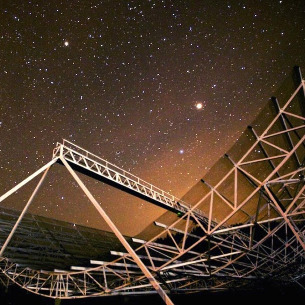
Our data comes from the CHIME telescope, in British Columbia, Canada. CHIME is uniquely good at finding FRBs because it can look at big chunks of the sky at a time (with a field of view of about 200 square degrees, or about 1000 moons). That's because of its unusual shape - four half-cylinders lying parallel along the ground, open sides facing up, like a scientific skate park (half-pipe, anyone?).
CHIME is the most advanced telescope for detecting FRBs, detecting hundreds of strong signals each day. However, we don't have the storage space to save them all forever - radio data is huge! - so we need your help to prioritise. Each week, we'll upload images of the most recent signals from CHIME. Tell us which ones might have fast radio bursts so we know to keep them. And quickly please, before our hard drives fill up!
We'll start off with small batches of the brightest few hundred signals per week. Once we've checked our systems work, we'll add thousands or even tens of thousands of fainter signals.
You can read more about CHIME at https://chime-experiment.ca/en.
You
CHIME records far more candidate bursts than the project scientists can look through. We need your help to sort through these candidate bursts, and tell us which are fast radio bursts and which are noise from humans. Then we can study the fast radio bursts to look for patterns, repeating signals, or common areas of the sky, to try to work out their origin.
Alongside you, we are also using a machine to make automatic classifications. This machine learns from you - the more you classify, the better it gets (we hope). Bursts from space are rare; soon, we hope to use the machine prioritize which bursts are most likely to be real, so we can show these to you first.