


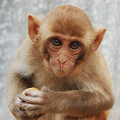
🐵 Single Cell 7 is our top priority! 🐵
Want to see Single Cell workflow examples? Check out #singlecellexamples
Research
Overview of Research Project
This project is part of a larger collaborative project investigating how genes influence social behavior using rhesus macaque monkeys as a model. These highly social monkeys are excellent models for understanding human social behavior and aging. What we learn by studying the monkeys can be used to help us understand similar processes in humans. We study the behavior of these monkeys and also collect genetic and other data from the same monkeys. We collected blood to make smears that we can characterize to help us understand monkey health in the population. Since whole blood contains many different types of cells, we need your help to identify the types of cells in the whole blood from each animal. These data will be compared between animals to help us determine the number and kinds of cells in the average monkey in our population, and to then understand which ones are healthy and which may be sick. Next we can compare this blood count information with the behavioral measures on the same monkeys to see how animal health contributes to differences in their behavior.
Rhesus Macaques

Rhesus macaques are Old World monkeys (monkeys that are native to Africa and Asia) and they are much more closely related to humans than mice. Their adult height is around 1.5 feet high and they weigh around 11-17 pounds. They are sexually dimorphic, meaning the males and females have different physical features and characteristics (e.g. different size and weight). These highly social animals form different social groups. Females stay with the social group they were born into, but the males disperse to a new group once they are sexually mature. We study the behavior of individual animals to compare to other metrics of health, such as blood counts.
Cayo Santiago
Cayo Santiago is a small island off the eastern coast of Puerto Rico. A free-ranging population of more than 1,000 rhesus macaques inhabits this 37.5 acre island. Since 1938 when the monkeys were brought to the island from India, scientists have been studying their behavior and, more recently, investigating their genetics to better understand the monkeys and their connection to humans. This primate field site has been under study longer than any other primate field site in the World!

Hurricane Maria caused severe damage to the island of Cayo Santiago where these monkeys live, but this presents an opportunity to understand how natural disasters impact animal (and human) health and behavior. Read about the effects of Hurricane Maria on this population in the 2021 publication below.
Social Behavior Collection
Members of our research team collect daily behavioral data on specific animals (called focal animal follows) on the island of Cayo Santiago. The animals are used to humans being on the island so human presence does not seem to impact their behavior. Each animal has a unique ID so the amount of time it spends alone, with other animals, grooming, eating, etc. is recorded. The behavioral information for each animal is then compared to other metrics of health, such as blood counts, to help us understand some of the forces causing differences in their behavior.

Blood Typing

Whole blood is collected from a subset of animals living on Cayo Santiago each year. This blood is used for genetic testing (to extract DNA) and is also used to assess animal health by studying the types and numbers of blood cells. We have developed a pipeline to assess blood smear images from the rhesus macaques on Cayo Santiago. We select animals for which we have genetic and behavioral data and additional blood for other genetic work. Whole blood is smeared across microscope slides and is stained to better distinguish the types of cells in the blood.
This pipeline involves using a microscope to view (or take images of) individual microscope slides with monkey blood. We count the number and types of blood cells (red blood cells, white blood cells and platelets) in images from individual animals. We next classify the white blood cell types (neutrophils, lymphocytes, monocytes and, rarely, basophils and eosinophils). We assess the animals for: unusual red blood cell shapes (this could signify a specific disease in an animal), unusually low or high numbers of white blood cell types (this could signify an animal with an infection), and high numbers of normally rare white blood cells (this could signify a diseased animal).

Use of AI/Machine Learning
Machine learning is currently used to help streamline project images for easier marking by volunteers and easier summarization of the user classifications. This is how the "Single Cell" workflows were developed. Blood smear images are run through a machine learning model that looks for white blood cells and returns a cropped image centered on what it suspects is a white blood cell.
*Why we don't just use AI to identify the white blood cells in our images? *
While we have provided sets of QC'd images for students and researchers to test out models, they have not been successful at developing a successful model for our samples. This is likely due to the few examples we have of the rarer types of white blood cells. We also have had variable staining coloring and quality through the years which make the images more variable, as our regular volunteers have likely noticed.
Research goals
What will we do with the data and how does this tie into the larger project?
The number and types of blood cells will be compared across all animals in the population to determine the normal range for the monkeys on Cayo Santiago. This will allow us to identify animals that fall outside of this normal range to assess their health and determine any impact on their behavior and reproductive success (number of offspring). We will also compare each animal's genetic information to the blood count information to determine if there are genetic factors that impact their blood cell makeup. These comparisons will be valuable to understand how the differences in blood cell counts and DNA sequence correlate with aspects of their social behavior and aging.
Publications
2026 Paper - Relationship Quality, Sex, and Hurricane Exposure Predicts White Blood Cell Counts in a Free-ranging Primate Population
2021 Paper - Study finds survivors of weather-related disasters may have accelerated aging
Presentations
Check out an online presentation about our project in January 2024 HERE!