


Finished! Looks like this project is out of data at the moment!
Research
The Hunt for Galaxy Clusters
 |
We are on the hunt for galaxy clusters. By understanding galaxy cluster physics, we hold one of the keys to unlock the answers to questions such as: What is the nature of the Universe we live in? How did matter in the Universe start to gravitationally collapse? How did stars start to form? How did galaxies start to form? How did galaxy clusters start to form? Galaxy clusters can also provide tests of alternative theories of gravity (e.g. MOG, MOND). All the data in The Hunt for Galaxy Clusters come from the XMM CLuster Archive Super Survey (x-class), an X-ray galaxy cluster search in the archival data of the European Space Agency's X-ray observatory, XMM-Newton. |
The goal of The Hunt for Galaxy Clusters
There are many unknown galaxy clusters waiting to be discovered in our Universe. To discover them in the vast amount of space in the Universe and the huge amount of upcoming astronomical data, we need to automate this! We will create a program based on the newest machine learning techniques. To do this we need your help to classify the images of potential galaxy clusters so that we can train our galaxy cluster finder! |
Why can’t computers do this task?
 |
Even today, algorithms that created the dataset in The Hunt for Galaxy Clusters still can not properly distinguish galaxy clusters from other X-rays emitting objects (like point sources or nearby galaxies) or even from instrumental effects (like the enhancement of the X-ray emission by the chip edges and clusters hidden in high levels of background X-ray emission). Humans are generally better at finding galaxy clusters than current computer programs. We have the ability to simultaneously compare the X-ray images with the optical counterparts, which gives us more information about the cluster candidates than using the X-ray data alone. This task however is very tedious! (Image credit: Wocorcaman, deviantart) |
Optical images
Oschin Schmidt Telescope |
  |
UK Schmidt Telescope |
  |
The optical images you are about to see are not coloured in the typical way that you may be used to seeing in astronomical images. Here colour represents the amount of light hitting the telescope from a certain position on the sky. The areas of darker colour represent areas on the telescopes camera that have been exposed to more light. The optical spectrum is mainly dominated by the light coming from photospheres of individual stars residing in galaxies. So what you see are mainly individual galaxies and closer stars. All of the optical images in The Hunt for Galaxy Clusters come from The Digitized Sky Survey 2 DSS2, which used the Oschin Schmidt Telescope on Palomar Mountain (images credit: Palomar/Caltech) and the UK Schmidt Telescope (images credit: Australian Astronomical Observatory). |
X-ray images
 |
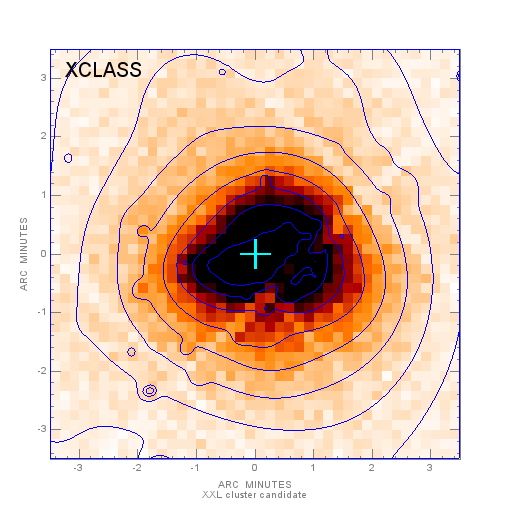
You are about to see the high energy Universe as seen in the X-ray. In this wavelength, light is invisible to our naked eyes and our optical telescopes. Colour in the X-ray images represents the amount of X-rays captured by pixels on our astronomical imaging camera detector (CCD). Darker colours represent more X-ray emission arriving at the telescope. The X-ray Universe is mainly dominated by various point sources and extended X-ray emission of hot intra-cluster gas. All of the X-ray images at The Hunt for Galaxy Clusters are made by the European Space Agency's X-ray Multi-Mirror Mission XMM-Newton satellite (image credit: European Space Agency). XMM-Newton satellite was launched on December 10th 1999 and is still operating. It had to be placed out of the Earth’s atmosphere as our atmosphere blocks out X-ray light. Unlike optical telescopes, X-ray telescopes do not reflect light using classical mirrors, as the X-ray light would either move freely through the mirror of a classical telescope or get absorbed. They instead are equipped with the series of coaxial paraboloid and hyperboloid mirrors, coated by gold to enhance reflectivity. X-ray light enters almost parallel to the mirrors which slightly alter and focus the X-rays into the focal point, where they are captured by the CCDs. As the CCD detectors are not only sensitive to X-ray photons but also to IR, visible and UV light, the cameras include aluminised optical blocking filters to reduce the contamination of the X-ray signal by those photons. |
Galaxy clusters
a) Introduction
Galaxy clusters are the largest structures in the Universe that are bound together by the force of gravity. They are composed of galaxies, hot gas filling the intra-cluster space and mysterious dark matter. Most of the galaxies in our Universe group into clusters. Those which are not a part of clusters are called the field galaxies. Clusters of galaxies have been found to be bright and extended X-ray sources. We now know the source of this X-ray emission is hot intra-cluster gas with temperatures of tens to hundreds of millions of degrees and low densities, ~ 7*1029 lower than density of our air. The mass of the X-ray emitting gas alone is greater than the mass of all of the cluster galaxies combined! However, the main mass component is not the mass of the intra-cluster X-ray gas, but the mass of the mysterious dark matter. If we compare the masses of all components, then ∼86% belongs to the dark matter, ∼12% belongs to the hot intra-cluster gas and only ∼2% of all mass of the galaxy clusters is in the galaxies themselves. Some alternative theories of gravity claim that dark matter does not exist. Studying galaxy clusters is one way to test these theories. |
b) Importance of galaxy clusters
One of the main interests of cosmologists is to understand how the structures we see in the Universe today came into being. It is widely accepted that the Universe started at the Big Bang. In the very first moments of its life, everything was extremely hot and smooth. How did matter in the Universe start to form clumps? How did stars start to form? How did galaxies start to form? How did clusters of galaxies start to form? These are some of the most basic but nonetheless some of the hardest questions to answer. As the largest structures in the Universe bound by gravity, galaxy clusters hold the key to the formation of structures in the Universe on the largest scales. By studying them in this project, we will improve our understanding of the Universe we live in. |
c) Age of objects and the speed of light
How can we know what clusters of galaxies looked like billions of years ago, when they started to form? How can we know what came before what we see now? Thanks to the finite speed of light, we do not see astronomical objects as they are in the present moment, but rather as they were at the time they produced the light. As we look further away, we see the Universe as it looked in the past. For example, the light from our Sun takes around 8 minutes and 20 seconds to reach the Earth; when a solar flare occurs, we see it only after those 8 minutes and 20 seconds. |
d) How do clusters of galaxies form?
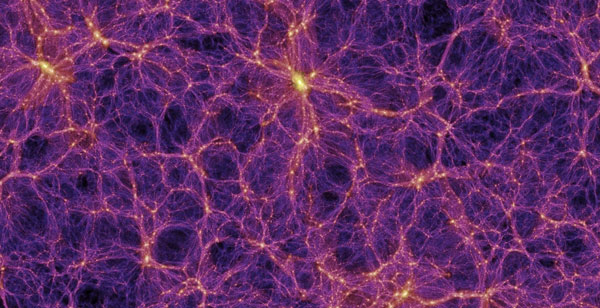 |
Under the influence of gravity, the tiny inhomogeneities in the early Universe grew, and dark matter and ordinary matter clumped together. Together with the effects of dark energy and the expansion of the Universe, the so called ”cosmic web” was formed (see image, image credit: Springel et al. (2005)). Clusters of galaxies form where the filaments meet. Older clusters tend to have a dominant giant elliptical galaxy at their core, surrounded by other elliptical galaxies. |