Finished! Looks like this project is out of data at the moment!
This project is now complete! The BIGGEST thank you to everyone who helped classify this dataset we hope you all had fun! We will now work on processing and analysing the data and will share this with you when it becomes avaliable!
Research
To start classifying images straight away click on 'classify' on the top right of this page. A tutorial will then appear on that page instructing you on what to do
Richmond Park 2024
In the spring of 2024, London HogWatch alongside Friends of Richmond Park (FRP) and The Royal Parks (TRP), deployed 150 cameras in Richmond Park to monitor and provide insight into the park's biodiversity. Cameras were active 24 hours a day for three weeks and collected over 600,000 images. We've used a trained Microsoft AI system called 'The Megadetector' to help reduce the amount of images that needed classifying. The dataset was run through the AI to remove human and blank images. Some blanks may have slipped through but the majority have been removed reducing our total amount of images down to 250,000.
Aims of our research
The classified data from this study will help us to understand the biodiversity that occurs in Richmond Park, such as the mammals and ground-feeding birds. We will be mapping species distributions as well as assessing activity patterns to research interactions between people and wildlife. These results will give important insights to aid urban conservation management both within the park and beyond.
We are also collaborating with UKHSA (United Kingdom Health Security Agency) to study tick populations around camera sites, exploring correlations between tick abundance and the mammal and bird species which host them. We hope to use these data to better understand and manage the risks of tick bite in the park and to better understand tick distributions in relation to visitor distributions.
Why Richmond Park?
At 2,500 acres, Richmond is the largest of the Royal Parks, with a unique mix of habitats from wetlands and meadowlands, to ancient trees and acid grassland. Because of its size and diverse mix of habitats, it is a key sanctuary for 144 species of birds, 29 species of butterflies, over 250 species of fungi, 1350 species of beetle and 11 species of bats – many of them rare. As a result of this immense biodiversity the park is a Site of Special Scientific Interest, a European Special Area of Conservation, and a Site of Special Importance for Nature Conservation. It is therefore vital that there is research and continued monitoring of the park's biodiversity to ensure conservation of these species.
Why camera traps?
Camera trapping is a fantastic monitoring tool for biodiversity as it enables remote recording of species and is highly regarded as a surveying method in ecological studies. The non-invasive nature of camera traps is advantageous for monitoring biodiversity and can provide valuable ecological insights of a study area. For example, using camera traps, information can be collected on a range of mammal species, such as red fox, badger, and hedgehog, as well as both common and elusive ground-feeding bird species. We can then use these datasets with a wealth of biodiversity information to look at species interactions and distributions, allowing for more effective conservation management strategies.
This work carries on from previous camera trap surveys conducted in the borough of Richmond by London HogWatch, including a survey of Bushy Park and other key green spaces as part of a project through the South London Partnership, as well as a small-scale survey of Richmond Park in 2018 of 40 cameras. These investigations gave us good ecological context to expand our survey to the whole of the park to allow us to collect more detailed biodiversity information that can feed into the parks management strategies.
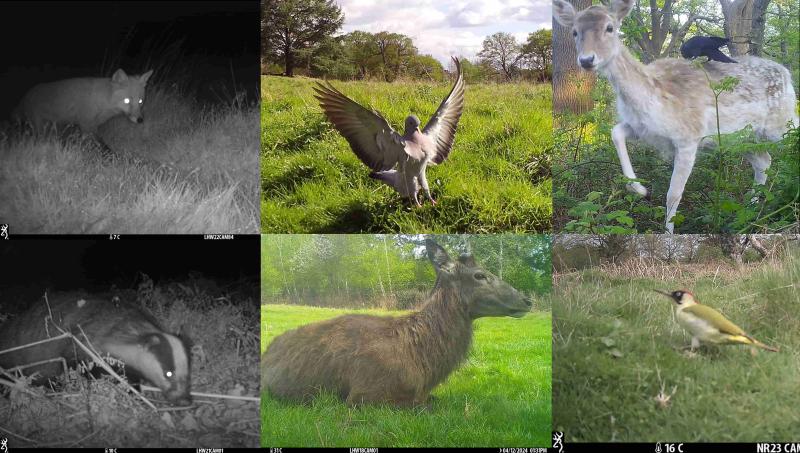
A collage of images from Richmond Park 2024
Who is behind this survey ?
The Richmond Park 2024 survey was carried out by London HogWatch, Friends of Richmond Park (FRP) and The Royal Parks (TRP). The survey and this Zooniverse project was funded by FRP. London HogWatch also receives core funding from British Hedgehog Preservation Society which enables us to carry out our work around London.
 Friends of Richmond Park - FRP are the key funder of the Richmond Park 2024 camera trap survey and of the creation of this Zooniverse project, their amazing large group of volunteers were also essential to deploying camera traps. Founded in 1961, the FRP is a charity dedicated to “the conservation and protection of Richmond Park and its peace and natural beauty for the benefit of the public and future generations” and to “advance public education about the Park”. Find more info here: https://www.frp.org.uk/.
 Royal Parks - The Royal Parks were key in supporting the Richmond Park 2024 camera trap survey. They are the charity that cares for the most famous collection of urban parks in the world. Providing free access to London’s beautiful, natural and historic green spaces, to help improve everyone’s quality of life and wellbeing. Find more info here: https://www.royalparks.org.uk/
 London HogWatch - is a Zoological Society of London (ZSL) based urban biodiversity project which aims to help combat hedgehog population decline in Greater London. They use systematic camera trapping surveys to collect data on hedgehogs and other London wildlife. The project’s key aims are to gain a better understanding of the abundance and distribution of London’s hedgehog populations to inform conservation management strategies, and gain a better understanding of Greater London's urban wildlife. They work with a diverse group of organisations such as London councils, local environmental groups, and businesses to inform local conservation efforts.
Between April and October, they carry out systematic camera trapping surveys across Greater London in a range of different habitats, including parks, gardens, and private green spaces. This allows them to collect data on the presence and absence of hedgehog populations. Camera trapping also means they can monitor the occurrence of other London wildlife populations that might impact hedgehogs. Analyses of the data enable them to address knowledge gaps about the occurrence, size, and connectivity of hedgehog populations. With this information, they can detect where habitats have become fragmented, for example, they have identified roads as a major threat for London’s hedgehogs, which prevents them from accessing otherwise suitable habitats.
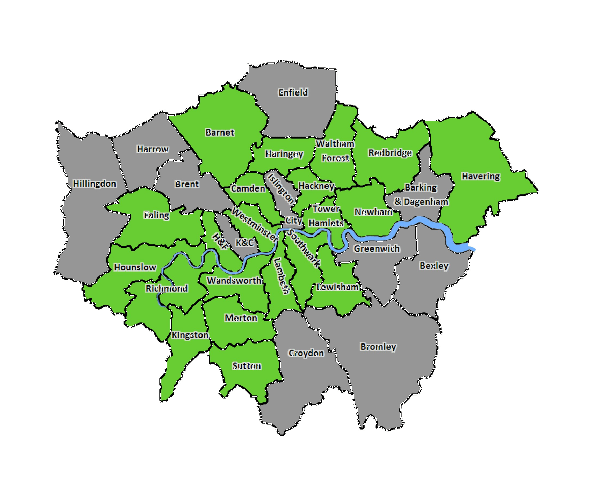
HogWatch continues to expand every year and has currently carried out surveys in two thirds of all London Boroughs and put out around 4,000 camera traps across London. The map below shows London boroughs in green which have been surveyed since the project began in 2016, each year the scope of our work continues to expand into new areas. Read more about the project here: https://www.zsl.org/what-we-do/projects/london-hogwatch