


Finished! Looks like this project is out of data at the moment!
We have finished the data collection. We are now further processing the data so it can be analysed and visualised. We thank each and everyone of you for all the time and effort you put into our project! We’ll keep you updated on our research results, here, on our blog and on Twitter.
Research

It seems probable, from many symptoms, that the microscope is about to become the idol of the day; we appear to be on the eve of a microscope mania.
Edmund Saul Dixon in Charles Dickens’ Household Words magazine, 1857
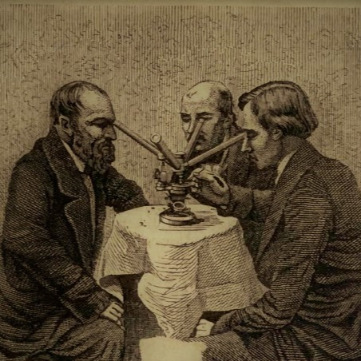
In the mid-nineteenth century, microscopy became immensely popular. Since microscopes were used in science, technology and medicine, practitioners in all three domains shared an interest in the instrument. And although the nineteenth century saw a specialisation and professionalisation of science, technology and medicine, microscopy continued to connect amateurs and professionals in various fields. This was facilitated by a wealth of newly available journals and handbooks on microscopy, which were widely distributed and circulated across Europe and America.
Microscopy publications invited microscopists to contribute and exchange material. They made it possible for microscopists in Europe and America to work together and spurred the formation of a strikingly diverse microscopy community. Illustrations of microscopic “worlds of wonder” were abundant in microscopy publications and made them particularly appealing. Often, illustrations and texts would be copied and reprinted, thus targeting several readerships at different places at the same time.
The purpose of Worlds of Wonder
Research into the nineteenth-century microscopy community will help us to better understand how practitioners with different disciplinary and educational backgrounds can collaborate in science, technology and medicine, even across national borders. Who could contribute their research to the community and how? Where did their contributions travel and how did they change along the way? We also hope to learn more about processes of discipline formation, as some nineteenth-century microscopists considered their field a scientific discipline in its own right.
To answer these questions, we ask for your help. Publications can be searched for terms, but it is a lot more difficult to identify and classify illustrations. Yet illustrations were crucial in determining research objectives and demarcating the domain of "microscopical science". We therefore ask you to analyse microscopy illustrations in nineteenth-century publications and identify their contributors. By doing so, you will make it easier for historians of science, technology, medicine and print to search and analyse a wealth of illustrations which crossed disciplinary and national boundaries. We are particularly interested in reproductions of illustrations, so please let us know on Talk if you see an illustration more than once!
Worlds of Wonder is conducted by researchers of the Science, Technology and Society Studies research group at Maastricht University (MUSTS). The digitised microscopy publications used in this project are hosted by the Biodiversity Heritage Library (BHL). Worlds of Wonder was inspired by Science Gossip of the ConSciCom research group, another Zooniverse project asking volunteers to classify illustrations, and we are indebted to their work.