


All subjects for this study have now been counted!
Thank you to everyone who participated and counted penguins with us!
There may be more counting next season - we'll let you know!
Research
Background
Antarctic krill are tiny crustaceans that are the keystone species and the foundation of the Antarctic food web, meaning they are the primary food source for fauna of the Antarctic and Southern Ocean, underpinning the region’s ecosystems. Tracking the number of Antarctic krill is very difficult due to their size and underwater habitat.
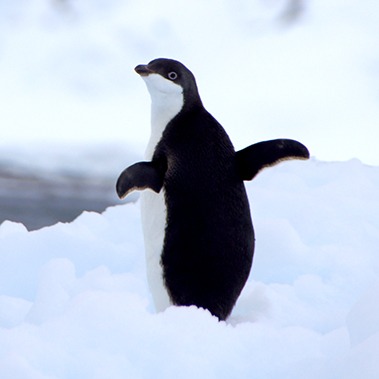
Instead, we track “indicator species” such as Adélie penguins – the focus of this study – whose population increases or decreases depending on their food source. Photographs of Adélie penguin colonies are taken from a helicopter during nesting season when one of a mating pair are often stationary in predetermined nesting areas or colonies.
Producing accurate counts, or censuses, from these photographs allows us to track the population of Adélie penguins, which in turn allows us to monitor the population of Antarctic krill.

Adélie penguins nesting. Photograph provided by Dr. Ursula Rack.
Krill Populations
Overfishing, as well as effects from climate change continue to put krill populations at risk, which impacts those predators who rely on them to survive. Their decline has been related to the reported deaths of humpback whales among other concerns from environmentalists about fragile ecosystems in the region.
There is increasing concern about the population of krill after a crucial conservation measure (CM 51-07) lapsed in 2024, leading to the fishing industry hitting its annual quota of 620,000 metric tonnes for the first time ever, and its unprecedented early closure in August of this year. For context, the annual catch in 2007 was 104,728 metric tonnes, jumping to 424,203 metric tons in 2023.
Counting Adélie Penguins
One of the major advantages to using Adélie Penguins as an indicator species is their visibility from the air. Since 1981 Antarctica New Zealand (ANZ) has surveyed the Ross Island colonies and taken photographs from a helicopter. These images form the basis of the census counts which represent the officially reported populations.
In order to determine whether there are inaccuracies in the counts, other counting methods need to be explored. One of these is the Zooniverse count which will be used to determine where and why any differences in census counts occur. The goal is to ensure there is a complete and accurate census so that any change in the population can be closely monitored to support future conservation.
Any inaccuracies in census counts could potentially hide a population downturn. Larger penguin colonies can number in the hundreds of thousands, and, if they are miscounted by even a small percentage each year, we could miss a population change that represents a real environmental issue. Monitoring their populations accurately and in a timely manner is critical if we are to protect our Antarctic ecosystems.

Adélie penguins returning from sea. Photograph provided by Dr. Ursula Rack.
This Project
In analysing the various census counts, this project will determine where, when and how often miscounts occur. The more people that analyse these images, the clearer the picture we can get of what (if anything) is causing differences between counts.
With the data from your counts, analysis will be conducted in relation to the location and severity of any differences. We will be able to determine if the differences relate to the images themselves, such as angle or height, or whether there is a consistent area, such as the nests on volcanic rock, that is causing problems.
Behind the scenes we are also using various imagery processing techniques and software. There will be images that are subsets of the actual photography, and images that are pieces of a separately created mosaic. Any variations in your counts will be monitored to determine whether there are ways we can improve our images to drive more consistent results.