


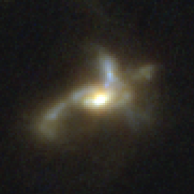
We are happy to announce our second project using data from the MEGA survey! Over 2000 new images are now available for classification!
Research
You might notice some differences! If you classified here before, you may remember things being a little different. We've pivoted the project somewhat, so please bear with us while we update the rest of the site to match our new format and science goals. The main difference is that instead of a 3-panel image with composite, g-band, and mid-IR shown, we show just one image, and with much less extra information associated with it.
How Do Black Holes Grow?
Every large galaxy has a supermassive black hole in its center. These black holes are a million to a billion times more massive than our Sun. An open question of galaxy evolution is how these black holes reached their enormous sizes. Since black holes can't radiate on their own, we can only observe them when they are actively consuming matter, because as they feed, the infalling matter gets extremely hot. Currently, the "standard model" of black hole growth is that they are fed by galaxy mergers; when two galaxies crash together, the gas in each galaxy can be funneled into black hole, causing it to grow. The black holes of each galaxy can merge into a single, more massive black hole, leading to growth as well. However, this is a theoretical model; the question of whether black hole growth is actually driven by merging galaxies is hotly debated; to date, studies have found correlations or a lack of correlations between galaxy interactions and black hole growth depending on the populations examined. Now, with cutting-edge observations and your help, we can determine once and for all if mergers are necessary to grow a supermassive black hole.
The James Webb Space Telescope
Past infrared (IR) surveys have been relatively low resolution and restricted to only the most massive or nearby galaxies. With the launch of the James Webb Space Telescope (JWST) and the release of the first wide field surveys, a new set of fainter, redder, more distant galaxies is now available for study. This more complete population of galaxies, like our own Milky Way but in the very early Universe, can provide new insight on how supermassive black holes grow.
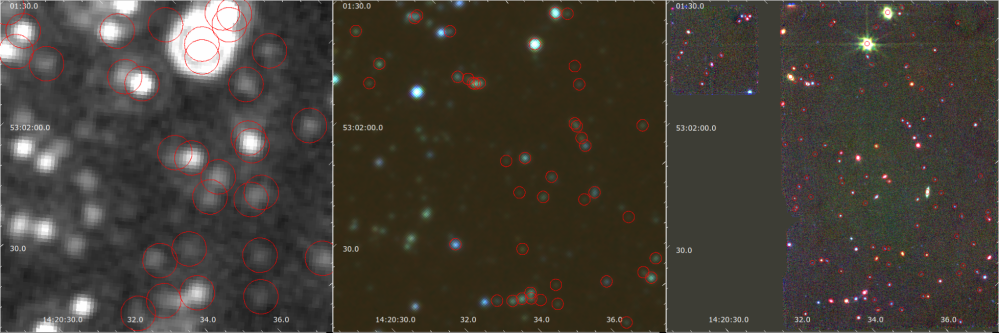
This image (source) shows the same area of the sky observed by both JWST and the last generation near- and mid-infrared telescope, Spitzer. The left panel is the Spitzer observation in the mid-IR, the middle panel is the Spitzer observation in the near-IR, and the right panel is the JWST observation in the mid-IR. This is to illustrate just how much more capable of an extragalactic observatory JWST is; in the past, only the brightest galaxies were detected, and they just looked like circles or blobs. Now, we can see much smaller, dimmer things.
In addition, for the first time in history, galaxy structure is visible in the infrared thanks to JWST's excellent angular resolution. Mergers are only reliably detected in resolved populations, either through visual classifications or through analysis of light distributions in a resolved source. This is therefore the first time a study of this type is possible. Together with your help, we will use this exquisite data set to understand how black holes have grown over the last 10 billion years.
Finding Black Holes
When black holes feed on matter, the light they emit is unlike anything else in the universe. Active black holes emit light at all wavelengths, from the radio to the X-ray. In some wavelengths, like the optical, this light can be hard to distinguish from starlight. However, in the infrared, the light follows a pattern called a power law, which can easily be identified even among other sources of thermal IR light, like old stars and dust. We use the brightness of different wavelength IR observations from James Webb to estimate the relative contributions of different sources using a process called Spectral Energy Distribution (SED) fitting. SED fitting allows us to extract a lot of different physical properties, including the fraction of light from the galaxy which is emitted by a central black hole.
Once we find a black hole using this process, then we check whether or not it lives in a merging system using the the data that you will help us create. Doing this for thousands of galaxies, and comparing what we observe to what we expect to find, will allow us to tell if black holes tend to live in merging systems and if this tendency is enough to explain their current sizes.
Identifying Mergers
This is where we need your help! Astronomers have come up with many clever ways to sort galaxies by type, but unfortunately there are not many ways to uniquely distinguish mergers from non-mergers. This is because they can happen between any kind of galaxy, and so their appearances, colors, and physical properties are extremely varied and mixed. The best way to find them is by visual inspection, to determine if they look like two galaxies colliding. To do that, we need a lot of fresh eyes on our images! Some of these galaxies are located as far back in time as just a few billion years after the Big Bang - you might be the first person to ever look at them!
We look forward to seeing what you find out there!