



You may notice changes to the ‘Done & Talk’ pages! The Zooniverse team is testing out some new Talk designs, and these changes are only available on a few projects right now, so they would love your feedback. Click here to share your thoughts: https://forms.gle/stgM6H6ioUp42CjF8
Results
Thanks for all your hard work!
By becoming a Dark Energy Explorer you are helping us find distant galaxies and false detections from our telescope that is working towards solving the mystery of Dark Energy! We have approximately 40% of you working on the mobile device and almost 20,000 individual volunteers all over the world. Together, you have reached OVER 6 MILLION galaxy classifications since our launch date on February 23, 2021! THANK YOU!
Results from "Fishing for Signal in a Sea of Noise"
By swiping left and right to identify real galaxies, you are helping us to build a catalog of galaxies to map the universe! We are gathering your classifications of fake detections and real galaxies and using them in our machine learning research.
What is machine learning?
Machine learning algorithms build a model based on sample data, known as training data (this is your classifications!), in order to make predictions or decisions without being explicitly programmed to do so. We use those classifications as a pure training set for machine learning! The unsupervised machine learning algorithm we use clusters the data based on certain features in the images, and then we use your classifications to understand what each of the clusters means! This is an efficient and more accurate way than using machine learning alone!
How are we using your classifications?
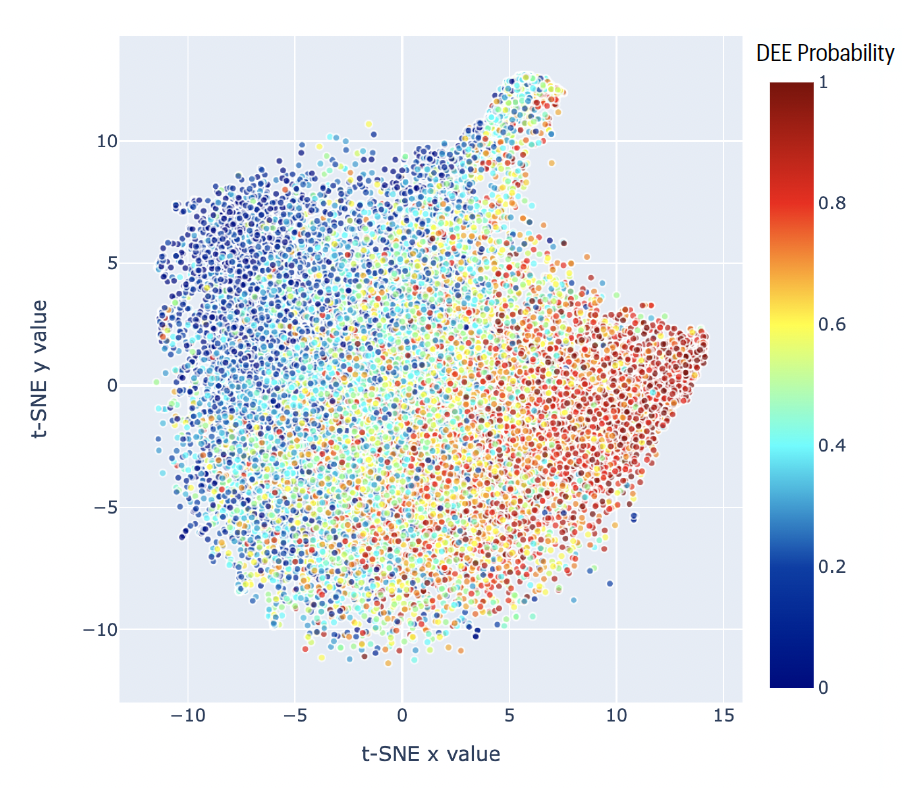
We use your classifications of galaxies to keep and galaxies that need to be looked at again as the understanding for machine learning. Specifically, we use the t-SNE algorithm that allows us to visualize data like the images below. In this image, we see two distinct clusters where the Dark Energy Explorers (DEE) probability, i.e., your classifications, are showing the 'fake' galaxies (DEE probability = 0, blue) and the 'real' galaxies (DEE probability = 1, red). We have at least 10 participants look at each image, and then we average the classifications to determine the DEE probability. We can then remove the 'fake' or false detections from our data catalog, creating a pure sample of data for us to conduct research on Dark Energy!

Results from "Nearby VS Distant"
Here is an example of how you guys did better than our data model! This is why visually looking at these objects is so important! This is from the 'Nearby VS Distant' workflow.
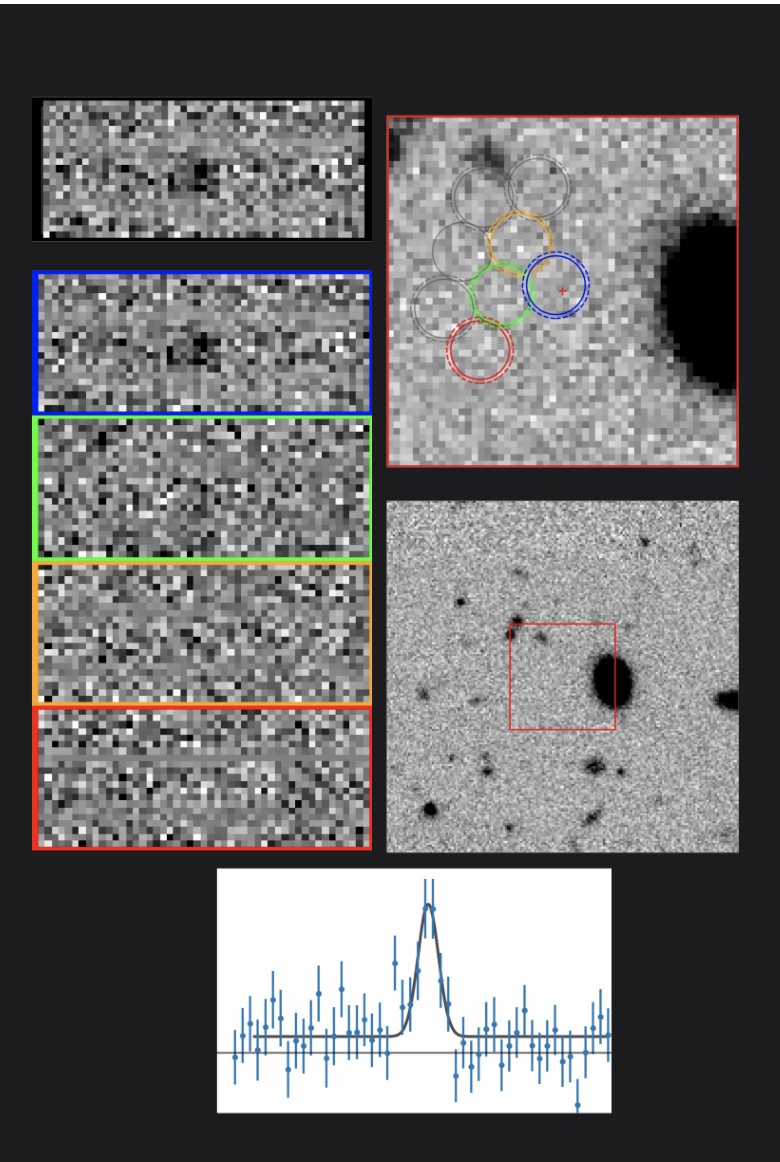
Our data model was fooled by the large source to the right (thinking it was a Nearby Galaxy), but YOU saw the dots in the colored blocks image and a faint, small dot/nothing in the zoomed-in image (which indicated a Distant Galaxy!). While our model picked up too much data from the large star next to it!
Once you classify these objects we take your classifications and use them in our machine learning algorithms. We couldn't use these algorithms accurately without your help in classifying nearby and distant galaxies!
Want to learn more and become a better classifier?
Here's how to learn what these different interesting objects look like!
Black Hole:
Black holes will appear like a larger wide oval rather than a dot. For example,
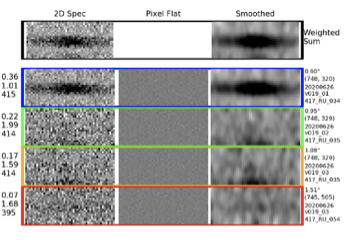
Black holes will also have a broad spectral line that is much wider than the usual tall slender spectral line.
