


All our pension forms have now been fully transcribed. Thanks to everyone who has contributed to our project, your help is very much appreciated. Our results page contains some preliminary findings and more can be found on our website and our data mapper.
Results
Addressing Health initial findings December 2023
We’d like to say thank you to everyone who has contributed to our transcription project. The data derived from the transcriptions has now been cleaned and coded, and analysis is ongoing. Here we will give you a brief overview of the general trends in the data but you can find out more from our website, where there are a series of working papers which describe the data collection process along with how we coded the cause of retirement data, you will also find details of any publications which emerge from the project. In addition, you can examine the data yourselves through our Data Mapper which allow you to map and chart various aspects of our data and to download a version of the data if you want to run your own analyses.
Our project uses the pension records of 26,500 Post Office workers who retired between 1860 and 1908 to examine health during their working lives and after retirement. The great strength of these records is that they provide detailed information on ill health during the worker’s lifetime and this information can help us fill a gap in our knowledge. Thanks to work by historians, geographers, demographers and epidemiologists we already know a great deal about how and why people died in the United Kingdom in this period but we know relatively little about the diseases people lived with and how ill health affected their lives.
Perhaps the most basic but important piece of information contained within these records is whether the worker in question retired because they reached the retirement age (60, raised to 65 after 1892) or because they had a medical condition which prevented them performing their duties. This medical condition had to be certified by a Post Office Medical Officer, doctors who were employed part time to attend to the health of the postal workforce. Figure 1 shows the proportion retiring for medical reasons as a percentage of all retirees in each year broken down by their country of work. There was considerable variation year-on-year, so the trends have been smoothed to a five-year moving average. Using moving averages allows us to examine the trend without the distraction of particularly high or low years.
This figure shows that the proportion retiring for medical reasons increased over time until the late 1890s when the share dropped substantially. This drop was caused by the sudden increase in the number of women in the database who were resigning in order to marry. These individuals hardly appear in the pension records prior to 1895. After 1895 they make up more than half of the female retirees in those years, and between 13-27 per cent of all retirees. If they are excluded from the data then the trend in the proportion of medical retirees continues at the same levels as seen in the early 1890s, with 63-75 per cent of workers retiring for medical reasons. These data, therefore, that it was increasingly common for workers to have ailments or diseases which prevented them from performing their duties, suggesting that something was making the workforce as a whole less healthy over this period.
However, there are interesting differences by place, with Scotland showing lower rates of medical retirement, although a similar trend to the other parts of the United Kingdom. We are, at present, unsure how to explain this. It may be that Scottish medical officers were less willing to sign off medical retirements, or perhaps the work undertaken in Scotland was substantially different from that done in England and Wales or Ireland, and less prone to being disrupted by the kinds of medical conditions common amongst postal workers, or perhaps the Scottish workforce was in some way ‘healthier’ than their counterparts elsewhere. We know that rates of medical retirement varied by occupation; for example, postmen and women were less likely to retire for medical reasons than indoor workers such as telegraphists or clerks. We also know Scotland had fewer indoor workers than the English or Irish workforces; thus, the workforce and the kind of work done in Scotland was less likely to result in medical retirements. However, this does not explain the difference entirely, as workers in the same occupation in different locations had different rates of medical retirement; for example, 66 per cent of English postmen and women retired for medical reasons, whereas in Scotland the figure was just 52 per cent. Something else must explain this difference.

Figure 1. Medical retirements as a share of all retirements by country, 1860-1902.
Much of the change over time in figure 1, and the difference between countries, reflected the different ages of the workers who retired. As workers got older, they became less likely to retire for medical reasons. The availability of medical retirement meant that those workers likely to retire for medical reasons were selected out of the workforce at younger ages. This left a group of workers who were not likely to suffer from a medical condition which prevented them working until they reached retirement age. In part this was because work changed as employees aged; they could be assigned to less physically arduous duties, for example, or were promoted to roles involving work which was more likely to be compatible with the kinds of conditions associated with aging. If you were a postman who developed a bad back in their fifties, you may not have been able to continue carrying and delivering mail, but you might have been able to undertake more sedentary work such as supervising sorting mail.
The mean age of retirees fell as this period progressed, as the mean age of the overall postal workforce fell. This trend explains much of the pattern shown in figure 1, as the workforce is not so much getting less healthy as it is increasingly composed of workers who were more likely to retire for medical reasons. The Scottish workforce was slightly older, on average, than the workforce in the other countries, which also helps explain the geographical differences discussed above. This is shown in figure 2, which gives the mean age at retirement of workers in England and Wales, Scotland and Ireland. Again the presence of women retiring due to marriage from the second half of the 1890s onwards distorts the trend somewhat, if they are excluded each country’s mean age is fairly stable after 1895, rather than continuing to decline.

Figure 2. Mean age at retirement of postal workers by country, 1860-1908.
Perhaps the most novel and intriguing information contained in the pension forms comes from the absence tables. These tables, shown in figure 3, give information on how many days off sick an individual took in the ten years before they retired. These tables are so valuable because information of this kind, defined on a regular basis across time and pace, is very rare for this period.

Figure 3. Example sickness table, taken from Charles Edward Barth’s pension form, retired 1860.
From it we can see how much time off different workers took at different ages and in different places. Figure 4 shows the trend in average sick leave by location for our period. This shows that sick leave trends varied between countries. In England and Wales, the mean sick days taken per sick worker rose slowly until the early 1870s when it levelled off, remaining at a steady level until the mid-1890s when the mean fell. Ireland had a similar pattern but, the initial rise went on longer, until the late 1870s, and it rose to a far higher value. The Scottish trend, as with the medical retirements, looks rather different, with a steady, albeit fairly slowly, increasing trend across the period until a turning point in the early 1890s when the mean began to fall.
Individual officers’ sick leave was closely monitored by Post Office Medical Officers, so it is unlikely to just be the case that workers were taking leave unnecessarily on the scale needed to produce this pattern. Instead, it looks like the changing occupational make-up of the postal workforce affected this. Indoor workers, such as telegraphists, sorters or clerks, took more leave than outdoor workers, such as postmen and women. We do not, at present, know exactly why this was the case, but indoor workers tended to work long hours in cramped conditions, often in shifts and often at night, all risk factors leading to worse health outcomes. It is also possible that indoor workers themselves might have been less physically robust than the postmen and women who each day delivered the mail. The different countries also had different occupational compositions, which will help explain the different patterns seen in figure 4. Scotland had, for example, a lower proportion of indoor workers than England and Wales.
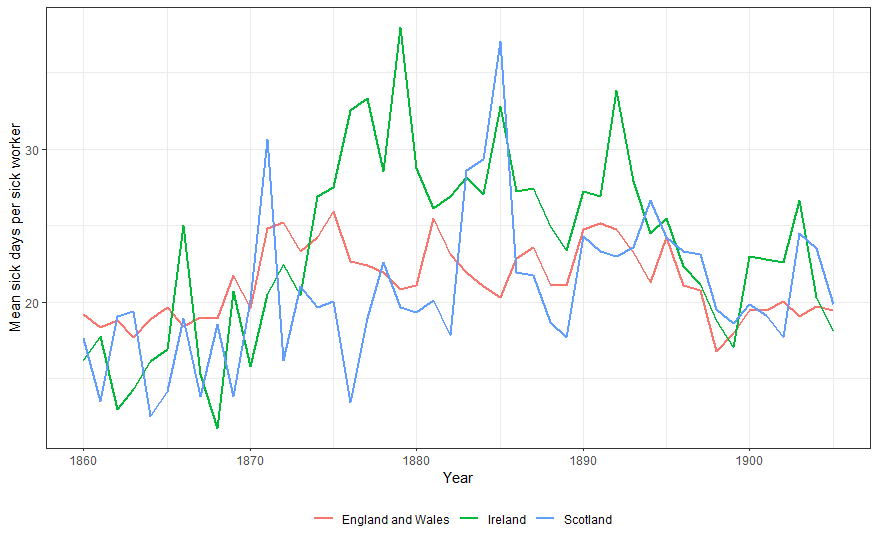
Figure 4. Mean days off sick by country, 1860-1908.
These three graphs only show some initial overall trends and there is much work remaining to interpret and explain these trends. In addition to the trends by place shown here, there are important differences between men and women, between different kinds of occupations and between different causes of retirement. Keep an eye on our website for further updates and analysis. Postal work, unlike mining or chemical manufacturing, was not a particularly deadly occupation, but it nevertheless had a large negative effect on workers' health causing long-term illness.