


Research
An Introduction to the Raphael Samuel Archive
As a historian Raphael Samuel is a fascinating figure whose attitude towards history had "neither structure nor limits. It was an unending and astonishingly learned perambulation round the wonderful landscapes of memory and the lives of common people" (Eric Hobsbawm). The treasure trove of information that he assembled over his career as a scholar of the everyday experience of Londoners is a chaotic kaleidoscope of different sources and fragments. Approaching it some two decades after his death in 1996, it remains a bewilderingly dense network of pages which, if properly analysed, could provide a fantastically rich, atmospheric, and nuanced reflection of life in the East End.
Samuel's self identified objective was the democratisation of history-making. If we want to use his archive in line with his academic principles the only way to do so this is to ask for the help of “citizen historians”. That is where you come in. By helping us you will be contributing to Samuel's prophetic ideal that we can all contribute to the construction of an historical narrative as individuals. The project will be relying on you to help sort, classify, and describe with a great deal of freedom the information you come across. Your perspectives and judgements will inform the historical research that comes out of this. It is a radically different methodology from the one normally undertaken by historians but we feel that it will produce a fascinating new approach to democratised historical research.
His archive is currently housed in the Special Collections of the Bishopsgate Institute, London, and consists of nearly one hundred folders often arranged by a common theme each containing a varying number of individual sheets . There the organisation ends and the viewer's individual desire to impose order on this chaos takes over. This project is an attempt to geographically map and network the archive, to return the names and places on these pages to the streets they describe, and to further engage with the social history that Raphael Samuel championed. To do this we need to extract as many of the places, people, and dates from the archive, tag, and describe them. This will be the first stage of a grander project that may stretch to the integration of multiple different archive collections to create a far more nuanced and detailed representation of Bethnal Green.

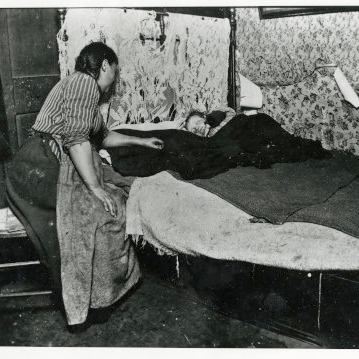
A family in Bethnal Green, circa 1880
Thanks and Acknowledgements
The project would like to thank: the Bishopsgate Institute, Special Collections and Archive; Doctor Nicholas Cole, Quill Project; The Master and Fellows of Pembroke College, Oxford; and Professor Alison Light
This project was supported by a grant from the John Fell Fund, University of Oxford.
Site images provided courtesy of the Bishopsgate Archive.