


Research
University of Aberdeen Lighthouse Field Station
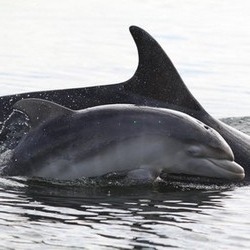
Since 1989, we have led a collaborative research programme on the ecology of the population of bottlenose dolphins that occur along the east coast of Scotland.
This work is based upon repeat observations of individually recognisable dolphins, providing data for a range of studies on abundance, reproduction, survival, social structure and epidemiology.
A key aim of our work is to support conservation programmes for this and other coastal dolphin populations. The Moray Firth Special Area of Conservation has been designated to protect bottlenose dolphins under the EU Habitats Directive, and the University of Aberdeen is contracted by Scottish Natural Heritage to make regular status assessments as part of the UK's Natura 2000 monitoring programme.
For more details check out our website at (https://www.abdn.ac.uk/lighthouse/)
Laser Photogrammetry
Measuring growth is difficult in wild cetaceans but is an important index of health and fitness. To solve this problem we integrated a novel technique using lasers with >25 years of demographic data from photo-ID research. This allowed us to investigate growth and survival in the protected bottlenose dolphin population on the east coast of Scotland.
We currently have thousands of laser photogrammetry photographs in need of analysis and need your help!
All you need to do is click on specific points on each dolphin photograph, and by using the coordinates from your clicks we can measure and work out the entire body length of each dolphin.
Check out the tutorials for more details.
For more information on this research, have a look at our Animal Conservation paper (https://doi.org/10.1111/acv.12384)