




Finished! Looks like this project is out of data at the moment!
Research
Mapping Galaxy History through Cosmic Encounters
When galaxies interact, their gravity can pull stars and gas outward into long tails, thin streams, broad fans, and delicate shells. These tidal features are physical debris from the encounter, and they’re some of the clearest signs that galaxies have influenced or collided with one another. You can spot them by looking for structures that don’t match the galaxy’s usual shape: light that stretches away from the core, asymmetries that break the galaxy’s symmetry, or faint extensions that seem disconnected from the main body. They can appear smooth or clumpy, straight or curved, and sometimes they’re barely brighter than the background sky.
A typical, undisturbed galaxy tends to be fairly symmetrical. The billions of stars inside it orbit around the galaxy’s center of gravity, which naturally pulls the system into an organized shape — potentially a smooth spiral disk or a rounded, elliptical glow. This symmetry reflects a galaxy that has been evolving quietly for a long time. But when another galaxy passes nearby or begins to merge with it, gravity starts to tug those orderly structures out of place. Stars and gas can be stretched, twisted, or pulled far from the galaxy’s main body. Astronomers look for these distortions in symmetry to uncover a galaxy’s past interactions. In many ways, this project is about spotting those cosmic fingerprints.
Below shows an example of a galaxy merger, NGC 2623, observed with Hubble Space Telescope. NGC 2623 is a late-stage galaxy merger whose nuclei have already merged (we call this “post-coalescent”) with multiple tidal features. We see tidal tails streaming off either side of the system, full of young stars born recently during the exchange of mass and gas in the merger.
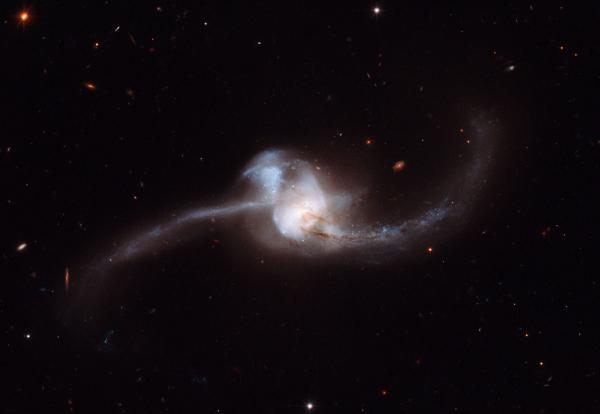
Credit: NASA, ESA and A. Evans (Stony Brook University, New York, University of Virginia & National Radio Astronomy Observatory, Charlottesville, USA)
The Hunt for Hidden Histories
To find tidal features, we need a telescope powerful enough to reveal the faintest smudges of light at the edges of galaxies. This is where Euclid comes in. Euclid is a space telescope launched by the European Space Agency in 2023, designed to map billions of galaxies across a third of the entire sky. What makes it special for our purposes is its combination of sharpness and depth: it can resolve fine structural detail while also picking up extremely faint light that ground-based telescopes would struggle to see through Earth's atmosphere. This makes Euclid uniquely powerful for hunting tidal features, which are often subtle, diffuse, and easily lost in the noise.
The catch is that no algorithm has learned to see the way you do. Tidal features come in an enormous variety of shapes — some bright and dramatic, some barely there — and no two mergers look alike. Machine learning models need clear, consistent rules to follow, but galaxy mergers don't play by clear, consistent rules. Humans, on the other hand, are remarkably sensitive to things that look "off": a faint asymmetry, a stretch of light that doesn't quite belong, a shape that breaks the expected symmetry of a galaxy. That instinct is exactly what this project needs.
This project has two workflows. In the first, you'll help us determine whether a galaxy is undergoing a merger and, if so, how many distinct galaxies can be identified. In the second workflow, for galaxies that do show signs of interaction, you'll identify which tidal features are present. Is there a long tail streaming away from the core? A faint shell surrounding the galaxy? A bridge of material connecting two systems? Each of these tells a different part of the story: what stage the merger has reached, how massive the two galaxies were relative to each other, and how their stars and gas responded to the gravitational disruption.
Our Project Goals
Together, we're building the first extensive, high-quality catalog of galaxy mergers and tidal features observed in Euclid Q1 — a resource that doesn't yet exist at this scale or depth.
This Euclid merger catalog will be a foundation for several lines of research. By linking what we see in the images to the underlying physics — how the galaxies approached each other, how their masses compared, how gravity redistributed their stars and gas — we can begin to understand not just what these encounters look like, but what drives them. And because Euclid sees galaxies across vast stretches of cosmic time, we'll be able to track how merger activity has changed as the universe has aged, tracing the role these collisions have played in shaping galaxies into what we observe today.
Your contributions also directly improve the machine learning tools we use alongside human classifications. The patterns you identify become training data, helping automated systems get better at recognizing the subtler signs of interaction. In this way, what you see informs not just this project, but the tools researchers will use for years to come.
Galaxies don't evolve in isolation. The universe you're helping to map is one built through billions of years of collisions, mergers, and gravitational encounters — and every image in this project is a snapshot of that ongoing process. We're glad you're here to help piece it together.
 |  |
This work is funded by NASA-Euclid grant # 80NSSC215K0005. Learn more about NASA Citizen Science Projects here: science.nasa.gov/citizenscience. This project makes use of Q1 data from European Space Agency's Euclid mission; learn more here: cosmos.esa.int/web/euclid/euclid-q1-data-release